![AWS Certified Big Data - Specialty (BDS-C00) Exam Guide: Complete Preparation for AWS Certified Big Data - Specialty (BDS-C00) [2026]](/_next/image?url=https%3A%2F%2Fstorage.googleapis.com%2Fdevcopublich%2Fblog-covers%2Famazon%2FAWS%20Certified%20Big%20Data%20-%20Specialty%2Faws-certified-big-data-specialty-bds-c00_cover.png&w=3840&q=75)
📋 Exam Quick Facts
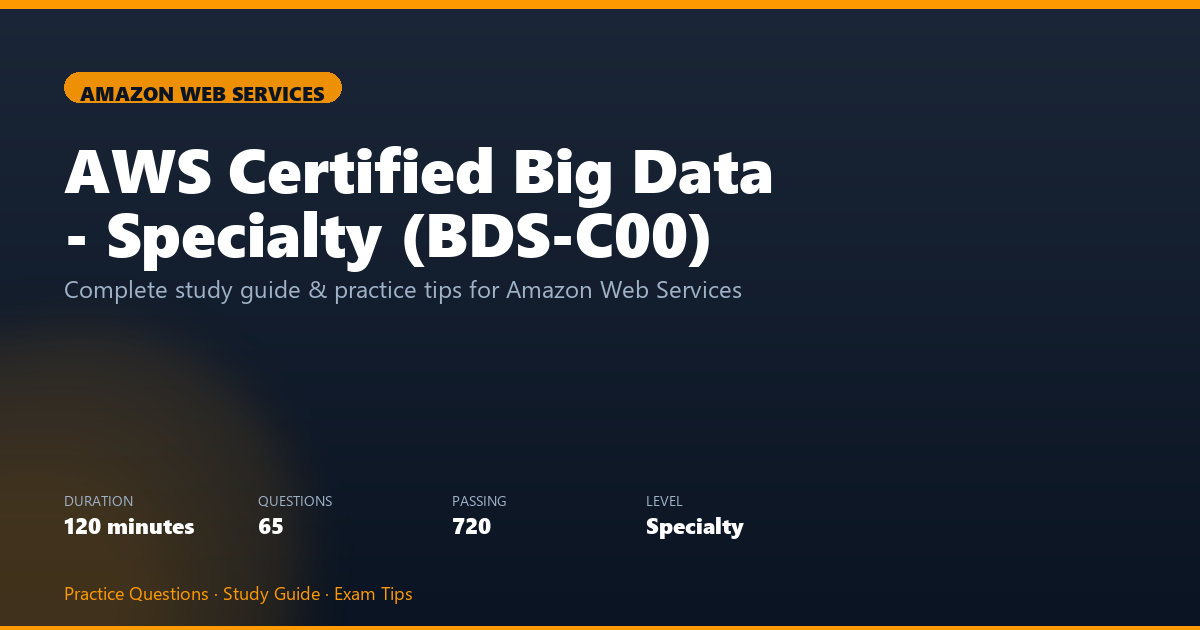
Detail Information Certification AWS Certified Big Data - Specialty (BDS-C00) Provider Amazon Web Services Exam Title AWS Certified Big Data - Specialty (BDS-C00) Duration 120 minutes Number of Questions 65 Passing Score 720 Exam Level Specialty Prerequisites Proven experience with AWS services, particularly in big data solutions.
📑 Table of Contents
- How to Pass the AWS Certified Big Data - Specialty (BDS-C00) Exam: A Complete Guide
How to Pass the AWS Certified Big Data - Specialty (BDS-C00) Exam: A Complete Guide
If you have ever watched a data pipeline fail at 2 a.m. because a single Spark job ran out of memory, you already know why big data skills matter. Cloud platforms make it easier to scale, but they also raise the bar: you need to design, secure, and operate data systems that stay reliable under pressure. The AWS Certified Big Data - Specialty (BDS-C00) certification is built for professionals who want to prove they can do exactly thatâarchitect and run production-grade big data solutions on Amazon Web Services.
This guide walks through what the certification is, how the exam is structured, what topics you must master, and how to prepare with a strategy that actually sticks. Whether you are a data engineer, solutions architect, or analytics specialist, the BDS-C00 can be a strong signal of depthânot just familiarityâwith AWS big data services.
What Is the AWS Certified Big Data - Specialty (BDS-C00) Certification?
The AWS Certified Big Data - Specialty (BDS-C00) is a Specialty-level credential from Amazon Web Services. It validates your ability to design and implement AWS-based big data solutions that collect, store, process, analyze, secure, and monitor large-scale datasets.
Unlike Associate-level exams that focus on broad cloud fundamentals, this certification expects hands-on judgment: when to choose Amazon EMR versus Amazon Athena, how to protect data at rest and in transit across a lakehouse architecture, and how to diagnose performance bottlenecks in distributed workloads.
| Attribute | Details |
|---|---|
| Certification name | AWS Certified Big Data - Specialty (BDS-C00) |
| Provider | Amazon Web Services |
| Level | Specialty |
| Prerequisites | Proven experience with AWS services, especially big data solutions |
| Validity | 3 years |
| Recertification | Recertify every three years, or maintain certification through AWS training and assessments |
Who should pursue it? Data engineers building ETL pipelines, architects designing analytics platforms, analytics engineers optimizing query performance, and security-minded practitioners responsible for governed data lakes. If your day-to-day work touches Kinesis, EMR, Redshift, Glue, Lake Formation, or related services, this exam aligns closely with real job skills.
Real-world scenario: A retail company ingests clickstream events from millions of mobile users, stores raw data in Amazon S3, transforms it with AWS Glue, and serves dashboards through Amazon Redshift. A BDS-C00-level engineer designs partitioning, compression, and IAM boundaries so the pipeline remains cost-efficient and compliant as traffic spikes during peak sales events.
Exam Overview and Structure
Understanding the exam format reduces unnecessary anxiety and helps you plan pacing. The BDS-C00 is a timed, multiple-choice / multiple-response exam focused on applied architecture and operational decision-making.
| Exam detail | Value |
|---|---|
| Exam title | AWS Certified Big Data - Specialty (BDS-C00) |
| Duration | 120 minutes |
| Number of questions | 65 |
| Passing score | 720 (scaled) |
| Question style | Multiple choice and multiple response |
| Focus | Architecture, processing, security, performance, monitoring |
Pacing math that matters: You have roughly 1.8 minutes per question. That is enough time if you practice under timed conditions, but tight if you overthink every distractor. A practical approach is to answer confidently first, mark uncertain items, and return with remaining time.
Expect scenario-based stems: long business requirements, partial architectures, and trade-offs around cost, latency, durability, and compliance. The correct answer is often the one that best balances AWS best practices with the constraints in the promptânot simply the most expensive or most complex service.
Tip: Read the last sentence of each question first. Many items bury the actual ask after a paragraph of context. Knowing whether you need the most secure, lowest cost, or lowest latency option changes how you evaluate answers.
Key Topics Covered
The exam domains map closely to how production big data systems are built and run. Use the table below as a study map, then deepen each area with labs and architecture diagrams.
| Domain | What you need to know | Services and concepts to prioritize |
|---|---|---|
| Big Data Architecture | End-to-end design of ingestion, storage, processing, and serving layers | S3 data lakes, Kinesis, DynamoDB, Redshift, EMR, Glue, Lake Formation |
| Data Processing and Analysis | Batch and streaming transforms, query patterns, orchestration | Spark on EMR, Glue ETL, Athena, Redshift Spectrum, Step Functions |
| Big Data Security | Encryption, access control, network isolation, auditability | IAM, KMS, VPC endpoints, CloudTrail, Lake Formation permissions |
| Big Data Performance Tuning | Throughput, query speed, cluster sizing, storage efficiency | Partitioning, columnar formats (Parquet/ORC), compression, Redis/ElastiCache patterns where relevant |
| Big Data Monitoring and Management | Observability, cost control, operational health | CloudWatch, EMR metrics, logging strategies, alarms, automated remediation |
Architecture: design for scale and change
Strong candidates can draw a pipeline from source to insight and justify each hop. Should events land in Kinesis Data Streams or Kinesis Data Firehose? Is S3 sufficient as a durable landing zone, or do you need DynamoDB for low-latency lookups? Architecture questions reward clarity about data temperature (hot/warm/cold), consistency needs, and downstream consumers.
Processing and analysis: choose the right engine
Batch jobs on EMR/Glue and interactive queries with Athena or Redshift solve different problems. The exam tests whether you know when serverless analytics is enoughâand when a managed cluster is justified by SLA, library needs, or complex Spark workloads.
Security: protect data without blocking teams
Encryption with KMS is baseline. Specialty-level thinking includes least-privilege IAM roles for jobs, column- and row-level controls in governed lakes, private connectivity, and auditable access paths. Security answers often fail when they grant broad permissions âfor convenience.â
Performance tuning: measure before you scale
Throwing larger clusters at a slow job is expensive and often ineffective. Look for opportunities in file layout, predicate pushdown, partition pruning, and right-sized executors. Performance questions frequently hide a storage-format or partitioning mistake behind a âcluster is too smallâ distractor.
Monitoring and management: operate like production depends on it
You should know which metrics signal backpressure, skewed partitions, failed stages, or runaway costsâand what remediation looks like. Monitoring is not only dashboards; it is actionable alerts and runbooks.
Real-world scenario: A fintech team streams transaction events into Kinesis, processes fraud features with Spark on EMR, and stores results in Redshift. After a latency spike, engineers discover uneven partitions and unoptimized Parquet files. Fixing partitioning and enabling better CloudWatch alarms restores SLA compliance without doubling cluster costâan outcome the exam loves to reward.
Study Tips and Preparation Strategy
Passing Specialty exams usually requires a blend of conceptual mapping, hands-on practice, and exam-style decision making. Use this phased plan over 6â10 weeks, adjusting for your current experience.
1. Build a service decision matrix
Create a one-page matrix for ingestion, storage, processing, query, and orchestration. For each use case (near-real-time, batch, ad hoc, ML feature store), write the preferred AWS service and one reason you would not choose it. This trains the comparison skills the exam demands.
2. Practice architectures, not trivia
Memorizing feature lists is brittle. Instead, redesign known systems: a clickstream lake, an IoT telemetry pipeline, a data warehouse modernization from on-prem Hadoop. For each design, write constraints (PII, RPO/RTO, budget) and defend trade-offs.
3. Lab the failure paths
Spin up small EMR or Glue jobs, break them intentionally, and watch metrics. Misconfigure IAM once and fix it. Query poorly partitioned Athena tables, then rewrite layout. Hands-on scars turn into fast exam instincts.
4. Study by domain weekly
Dedicate focused weeks to architecture, processing, security, performance, and monitoring. End each week with 20â30 mixed questions so domains stay connected rather than siloed.
5. Keep cost and operational excellence visible
AWS Specialty scenarios often include cost and manageability. Prefer answers that automate with managed services when requirements allow, and avoid over-engineering.
Practical tip: Maintain a âwrong answer journal.â Every missed practice question gets one line: what I assumed, what the prompt actually asked, the AWS principle I missed. Review that journal twice a week. It compounds faster than rereading whitepapers.
Real-world scenario: An analytics team migrates nightly Hadoop jobs to AWS. Candidates who only memorize âEMR runs Sparkâ struggle. Candidates who practiced job sizing, spot vs on-demand trade-offs, S3 committers, and Glue Catalog integration can justify a migration plan that cuts compute cost while meeting overnight SLAsâexactly the reasoning BDS-C00 tests.
Common Challenges and How to Overcome Them
Even experienced engineers hit predictable walls on this exam. Here is how to address them early.
Challenge 1: Too many overlapping services
Kinesis Streams vs Firehose, EMR vs Glue, Athena vs Redshift Spectrumâoverlap creates second-guessing.
Overcome it: Build comparison cards with three columns: best fit, limitations, typical exam clue words (near real time, fully managed ETL, interactive SQL over S3, complex joins at warehouse scale).
Challenge 2: Security questions feel âgotchaâ
Many wrong answers look secure but violate least privilege, ignore encryption in transit, or open public access unnecessarily.
Overcome it: For every architecture, ask: Who can read raw data? Who can write curated data? How is encryption keyed? How is access audited? If an option skips one of those, discard it.
Challenge 3: Time pressure on long scenarios
Dense stems burn minutes.
Overcome it: Scan for constraints first (compliance, latency, cost, managed vs self-managed). Eliminate two options quickly, then compare the remaining pair against the constraint keywords.
Challenge 4: Performance tuning without numbers
People guess âadd nodesâ instead of fixing data layout.
Overcome it: Practice a checklist: file format â compression â partitioning/bucketing â query filters â cluster/concurrency settings. Apply that order in practice questions until it becomes automatic.
Challenge 5: Underestimating monitoring and operations
Candidates over-prepare architecture and under-prepare CloudWatch metrics, logging, and operational controls.
Overcome it: For each major service in your study plan, list five metrics and one alert that would indicate real production pain (lag, failed jobs, throttling, storage growth, query queue time).
Why Practice Exams Matter (and What âGood Practiceâ Looks Like)
Reading documentation builds knowledge. Timed practice builds exam performance. The BDS-C00 rewards people who can apply concepts under pressure, and that skill is trainable.
Timed practice builds pacing and stamina
Sixty-five questions in 120 minutes is manageable only if you have rehearsed the rhythm: read, eliminate, decide, flag, move on. Untimed studying creates a false sense of readiness. Timed sets reveal whether you freeze on long scenarios or rush past critical constraints.
Detailed explanations turn mistakes into durable learning
A score alone is not feedback. Strong question banks explain why the correct option fits AWS best practices and why plausible distractors fail. That is how you stop repeating the same architecture mistakesâespecially around security boundaries and performance trade-offs.
A structured question bank prevents random studying
Random quizzes feel productive but leave gaps. A structured bank mapped to domains (architecture, processing, security, performance, monitoring) lets you diagnose weak areas, drill them, then retest in mixed mode. That cycle mirrors how the real exam blends topics in a single scenario.
PDF-style question banks help deep review offline
PDF-style practice sets are especially useful for focused review sessions: annotate tricky stems, highlight constraint keywords, and revisit marked items without interface distractions. They also support team studyâprint a set, debate answers, and compare reasoning. Used alongside digital timed exams, they reinforce pattern recognition rather than passive reading.
A subscription practice exam bank keeps prep current and consistent
A subscription-style practice exam bank gives you ongoing access to fresh sets, progress tracking, and repeated full-length simulations as your exam date approaches. Consistency matters more than cramming: short, frequent practice sessions with scored feedback outperform occasional marathon reading. Look for banks that emphasize realistic difficulty, clear rationales, and coverage across all BDS-C00 topic areas so your confidence is evidence-basedânot hopeful.
How to use practice effectively:
- Take a baseline timed exam to find weak domains.
- Drill those domains with targeted question sets and PDF review notes.
- Re-run mixed timed exams weekly.
- In the final 7â10 days, prioritize full-length simulations and explanation review over new theory.
If an answer explanation references a service behavior you have never used, schedule a short lab the same day. Connecting practice items to hands-on proof is one of the fastest ways to lock in Specialty-level judgment.
Conclusion and Next Steps
The AWS Certified Big Data - Specialty (BDS-C00) certification is a rigorous, practical credential for professionals who design and operate large-scale data platforms on AWS. Success comes from more than memorizing services: you need architecture judgment, security discipline, performance instincts, and operational awarenessâtested across 65 questions in 120 minutes, with a passing score of 720.
Your next steps:
- Map your current experience against the five domains and identify gaps.
- Build a 6â10 week plan that mixes labs, architecture drills, and weekly timed practice.
- Keep a wrong-answer journal and review it consistently.
- Use PDF-style question banks for deep offline review and annotation.
- Add a subscription practice exam bank for repeated timed simulations, structured domain coverage, and explanation-driven improvement until your scores are stable above the passing threshold.
Treat practice as a feedback system, not a scoreboard. When you can explain every missed question in plain languageâand defend the correct design under time pressureâyou are ready to sit the exam with confidence.
Big data careers reward people who can turn raw volume into reliable insight. Earn the credential, then apply the same rigor on the job: design clearly, secure carefully, tune deliberately, and monitor relentlessly. That is how BDS-C00 preparation becomes lasting professional capabilityânot just a badge.
Pass the exam with our practice question bank
Timed multiple-choice practice is one of the fastest ways to close knowledge gaps before test day. Use our PDF question banks for offline review and subscribe to the practice exam question bank for full access to realistic items, explanations, and a study flow aligned to the official blueprint.
- Question bank scope: Prep coverage tied to AWS Certified Big Data - Specialty (BDS-C00) draws from a curated pool of 65 discussion-grounded practice prompts aligned to the blueprint (totals reflect the dataset backing this guide).
- Learner benchmarks: 94% — Students found the real exam almost same
- Learner benchmarks: 1057 — Students passed this exam after ExamTopic Prep
Start practicing for this exam
Disclaimer: This blog post is for educational purposes only. Certification exam details may change over time. Always refer to the official certification provider for the most up-to-date information.
Comments
No comments yet. Be the first to share your thoughts.