![AWS Certified Data Engineer - Associate DEA-C01 Exam Guide: Complete Preparation for AWS Certified Data Engineer - Associate DEA-C01 [2026]](/_next/image?url=https%3A%2F%2Fstorage.googleapis.com%2Fdevcopublich%2Fblog-covers%2Famazon%2FAWS%20Certified%20Data%20Engineer%20-%20Associate%20DEA-C01%2Faws-certified-data-engineer-associate-dea-c01_cover.png&w=3840&q=75)
📋 Exam Quick Facts
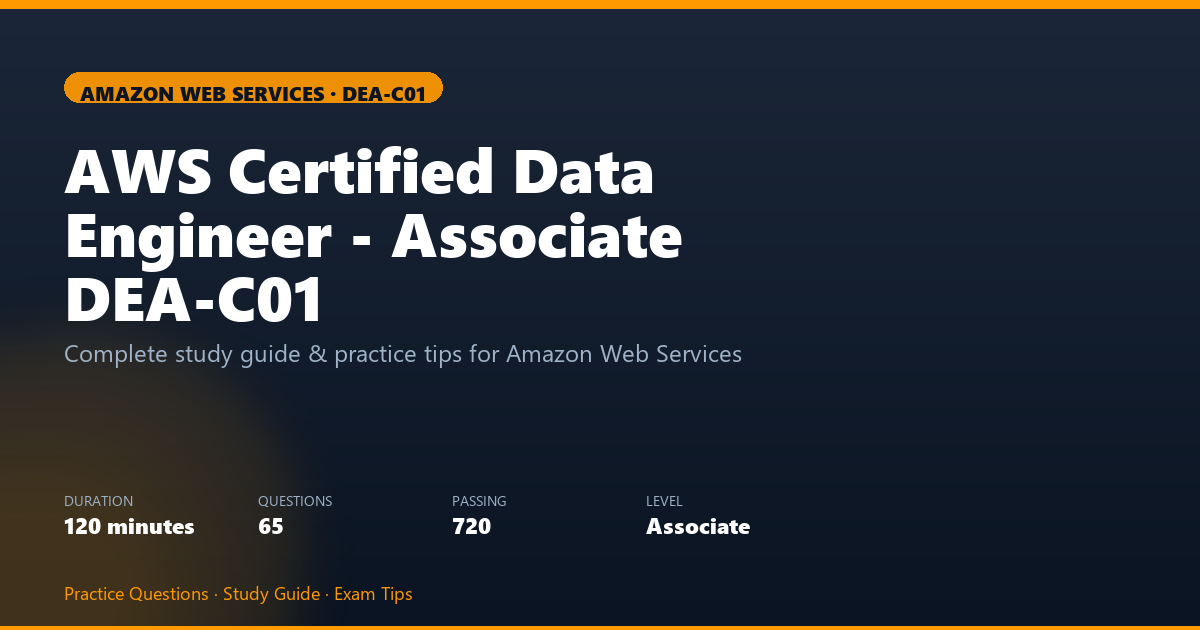
Detail Information Certification AWS Certified Data Engineer - Associate DEA-C01 Provider Amazon Web Services Exam Title AWS Certified Data Engineer - Associate DEA-C01 Duration 120 minutes Number of Questions 65 Passing Score 720 Exam Level Associate Prerequisites Recommended for professionals with at least one year of experience in data engineering or related fields.
📑 Table of Contents
- AWS Certified Data Engineer â Associate (DEA-C01): Your Complete Exam Guide
- What Is the AWS Certified Data Engineer â Associate (DEA-C01) Certification?
- Exam Overview and Structure
- Key Topics Covered
- Study Tips and Preparation Strategy
- Real-World Scenarios: How DEA-C01 Knowledge Applies
- Common Challenges and How to Overcome Them
- Why Practice Exams Matter: The Case for Structured, Timed Preparation
- Conclusion and Next Steps
AWS Certified Data Engineer â Associate (DEA-C01): Your Complete Exam Guide
The modern data stack does not build itself. Someone has to ingest streaming events from IoT sensors, transform raw JSON into queryable tables, enforce governance policies across petabytes of S3 data, and make sure the finance teamâs nightly reports finish before sunrise. If that sounds like your daily workâor the work you want to be doingâthe AWS Certified Data Engineer â Associate (DEA-C01) certification is one of the clearest signals you can send to employers that you understand how data engineering works on AWS, not just in theory, but in production.
Whether you are a data analyst stepping into pipeline ownership, a software developer moving toward analytics infrastructure, or an experienced engineer validating your skills, this guide walks you through everything you need to know about the DEA-C01 exam: what it covers, how it is structured, how to prepare effectively, and why deliberate practice matters as much as hands-on experience.
What Is the AWS Certified Data Engineer â Associate (DEA-C01) Certification?
The AWS Certified Data Engineer â Associate (DEA-C01) is Amazon Web Servicesâ associate-level credential designed for professionals who design, build, and maintain data pipelines and analytics solutions on AWS. Unlike general cloud certifications that skim many services, DEA-C01 goes deep on the services, patterns, and trade-offs data engineers encounter every day.
| Attribute | Details |
|---|---|
| Certification Name | AWS Certified Data Engineer â Associate (DEA-C01) |
| Provider | Amazon Web Services (AWS) |
| Level | Associate |
| Recommended Experience | At least one year in data engineering or a related field |
| Validity | 3 years; renew by passing the latest exam version |
| Target Role | Data engineers, analytics engineers, ETL developers, data platform specialists |
AWS positions this certification for professionals who can:
- Ingest and transform data from diverse sources
- Design data stores appropriate to workload requirements
- Implement data processing using batch and streaming paradigms
- Apply security, governance, and monitoring best practices
- Optimize cost and performance across the data lifecycle
Passing DEA-C01 tells hiring managers and clients that you can translate business data requirements into reliable, scalable AWS architecturesânot just draw boxes on a whiteboard.
Exam Overview and Structure
Understanding the exam format before you study helps you calibrate your preparation and manage time on test day.
| Exam Detail | Specification |
|---|---|
| Exam Code | DEA-C01 |
| Duration | 120 minutes |
| Number of Questions | 65 |
| Question Format | Multiple choice and multiple response |
| Passing Score | 720 (scaled score out of 1000) |
| Delivery | Pearson VUE testing center or online proctored |
| Cost | $150 USD (subject to regional pricing) |
What to Expect on Test Day
You will face scenario-based questions that mirror real architectural decisions. A typical question presents a business requirementâsay, a retail company needs near-real-time inventory updatesâand asks you to choose the best combination of AWS services, configuration, or troubleshooting step.
Questions are not purely definitional. AWS expects you to understand when to use Amazon Kinesis Data Streams versus Kinesis Data Firehose, why AWS Glue might be preferable to a self-managed Spark cluster for a given ETL job, and how to secure data at rest and in transit across a multi-account environment.
Time management is critical. With 65 questions in 120 minutes, you have roughly 1.8 minutes per question. Some questions will take 30 seconds; others involving multi-step scenarios may take three minutes. Flag uncertain questions and return to them rather than burning your clock on a single item.
Key Topics Covered
The DEA-C01 exam organizes content around five major domains. While AWS does not publish exact domain weightings publicly for every exam cycle, these areas represent the core of what you will be tested on.
1. Data Warehousing
This domain covers designing and managing analytical data stores. Expect questions on:
- Amazon Redshift: distribution keys, sort keys, concurrency scaling, RA3 nodes, Spectrum for querying S3
- Amazon Athena: serverless SQL over S3, partitioning strategies, cost optimization
- Data modeling: star schemas, slowly changing dimensions (SCD), denormalization trade-offs
- Performance tuning: vacuum operations, workload management, materialized views
2. ETL and Data Integration
The heart of data engineeringâmoving and transforming data reliably:
- AWS Glue: crawlers, jobs, Data Catalog, workflows, Glue Studio
- AWS Data Pipeline and Step Functions for orchestration
- Amazon AppFlow for SaaS integrations
- AWS DMS (Database Migration Service) for homogeneous and heterogeneous migrations
- Error handling, idempotency, and data quality validation patterns
3. Big Data Processing
Batch and streaming processing at scale:
- Amazon EMR: Spark, Hive, Presto, cluster sizing, spot instances
- Amazon Kinesis: Data Streams, Firehose, Data Analytics, Video Streams
- AWS Lambda for event-driven processing
- Amazon Managed Streaming for Apache Kafka (MSK)
- Choosing between batch, micro-batch, and true streaming architectures
4. Database Management
Operational and analytical database knowledge:
- Amazon RDS and Aurora: read replicas, Multi-AZ, backup strategies
- Amazon DynamoDB: partition keys, GSIs, TTL, DAX caching
- Amazon DocumentDB, Neptune, and Timestream for specialized workloads
- Migration strategies and schema evolution
5. Data Analytics
Enabling business insights from processed data:
- Amazon QuickSight: SPICE, dashboards, ML insights
- Amazon OpenSearch Service for log and text analytics
- Amazon SageMaker integration for ML pipelines (feature stores, batch transform)
- Data lake architecture on Amazon S3 with AWS Lake Formation for governance
Domain Summary Table
| Domain | Key Services | Common Exam Angles |
|---|---|---|
| Data Warehousing | Redshift, Athena | Schema design, query optimization, cost control |
| ETL & Integration | Glue, DMS, AppFlow | Pipeline design, error handling, orchestration |
| Big Data Processing | EMR, Kinesis, MSK, Lambda | Batch vs. streaming, scaling, fault tolerance |
| Database Management | RDS, Aurora, DynamoDB | HA, backups, key design, migration |
| Data Analytics | QuickSight, OpenSearch, SageMaker | Visualization, search, ML integration |
Study Tips and Preparation Strategy
Passing DEA-C01 requires a blend of hands-on experience, structured review, and exam-specific practice. Here is a proven preparation roadmap.
Phase 1: Baseline Assessment (Week 1)
Start by taking a diagnostic practice test under timed conditions. Note which domains feel weakest. Many candidates discover they are strong on databases but weak on streaming architecturesâor vice versa. Let data guide your study plan, not assumptions.
Phase 2: Hands-On Labs (Weeks 2â6)
Reading documentation alone will not suffice. AWS exams reward practitioners. Build mini-projects:
- Create a Glue crawler and ETL job that transforms CSV files in S3 into Parquet
- Stand up a Kinesis Data Stream with a Lambda consumer
- Load data into Redshift and optimize queries with sort keys
- Configure Lake Formation permissions across accounts
Use the AWS Free Tier where possible, but budget $20â50 for services that exceed free limits. The investment pays for itself in confidence.
Phase 3: Documentation Deep Dives (Weeks 4â8)
Read AWS service FAQs and best-practice guides. Pay special attention to:
- AWS Well-Architected Framework (Data Analytics Lens)
- Service quotas and limits
- Security best practices (IAM, KMS, encryption)
- Cost optimization recommendations
Phase 4: Review and Practice (Weeks 8â10)
Consolidate knowledge with flashcards, summary notes, and repeated timed practice exams. Aim for consistent scores well above the 720 passing threshold before scheduling your real examâtypically 80% or higher on quality practice tests.
Practical Study Tips
- Learn the âwhy,â not just the âwhat.â AWS questions test trade-offs. Understand why Firehose suits simple delivery but Kinesis Data Streams suits custom processing.
- Draw architecture diagrams. Sketching pipelines reinforces service relationships and helps you recall them under pressure.
- Study IAM policies for data services. Lake Formation, S3 bucket policies, and Glue resource policies appear frequently.
- Memorize key limits. Kinesis shard throughput, Lambda concurrency, Redshift node typesâthese details show up in scenario questions.
- Join study communities. Discussion forums and study groups expose you to edge cases you might not encounter alone.
Real-World Scenarios: How DEA-C01 Knowledge Applies
Exam content reflects problems you will actually solve. Here are three scenarios that illustrate the kind of thinking DEA-C01 validates.
Scenario 1: The Retail Inventory Pipeline
A national retailer collects point-of-sale transactions from 2,000 stores. Each store sends events to a regional endpoint. The data team needs near-real-time inventory visibility with a 15-minute maximum latency, and historical data must be available for monthly trend analysis.
The DEA-C01-relevant solution: Ingest events via Kinesis Data Streams (or MSK for Kafka-native teams), process with Lambda or Kinesis Data Analytics for real-time aggregation, land curated data in S3 partitioned by date and store, and query historical trends through Athena or load aggregates into Redshift. Glue orchestrates nightly batch reconciliation jobs.
This scenario tests your ability to blend streaming and batch patternsâa recurring exam theme.
Scenario 2: The Healthcare Data Migration
A healthcare provider must migrate 15 TB of patient records from an on-premises Oracle database to AWS while maintaining HIPAA compliance and minimizing downtime. The migration runs over a weekend maintenance window.
The DEA-C01-relevant solution: Use AWS DMS with continuous replication to sync data ahead of cutover, store encrypted data in RDS or Aurora with encryption at rest via KMS, enforce access through IAM and VPC security groups, and audit access with CloudTrail and CloudWatch. Glue validates data quality post-migration.
This scenario emphasizes security, migration tooling, and complianceâcore exam content.
Scenario 3: The Cost-Optimized Data Lake
A media company stores 500 TB of clickstream logs in S3. Analysts run ad hoc queries, but costs have spiraled because queries scan entire datasets daily.
The DEA-C01-relevant solution: Convert raw logs to Parquet with Glue ETL, partition by date and campaign ID, register tables in the Glue Data Catalog, enforce column-level access with Lake Formation, and query via Athena with partition pruning. Set up S3 Lifecycle policies to transition cold data to Glacier.
This scenario tests data lake optimizationâa practical skill and a frequent exam focus.
Common Challenges and How to Overcome Them
Every DEA-C01 candidate hits obstacles. Recognizing them early saves time and frustration.
Challenge 1: Service Overlap Confusion
AWS offers multiple ways to solve similar problems. Kinesis vs. MSK vs. SQS for messaging. Glue vs. EMR for ETL. Athena vs. Redshift for analytics.
Solution: Create comparison tables for overlapping services. Focus on the decision criteria AWS emphasizes: latency requirements, team expertise, operational overhead, cost model, and scale.
| Use Case | Better Choice | Why |
|---|---|---|
| Simple S3 delivery, no custom processing | Kinesis Firehose | Fully managed, minimal code |
| Custom stream processing with ordering | Kinesis Data Streams | Fine-grained shard control |
| Existing Kafka ecosystem | Amazon MSK | Native Kafka compatibility |
| Serverless ETL, catalog integration | AWS Glue | Managed Spark + Data Catalog |
| Complex Spark jobs, custom libraries | Amazon EMR | Full cluster control |
Challenge 2: Insufficient Hands-On Time
Candidates who study exclusively from videos or slides often fail scenario questions that require intuition about service behavior.
Solution: Dedicate at least 50% of study time to hands-on labs. Break things on purposeâdelete a Glue crawler, misconfigure an IAM role, overflow a Kinesis shardâand learn to diagnose errors.
Challenge 3: Underestimating Security and Governance
Technical candidates sometimes overlook IAM, encryption, and Lake Formation because they feel less exciting than streaming pipelines.
Solution: Treat security as a first-class study domain. At least 15â20% of your preparation should cover access control, encryption options, and audit logging across data services.
Challenge 4: Poor Time Management on Exam Day
Running out of time leaves points on the table.
Solution: During practice exams, enforce the 120-minute limit strictly. Develop a rhythm: read the scenario once, eliminate obviously wrong answers, flag ambiguous questions, and keep moving.
Why Practice Exams Matter: The Case for Structured, Timed Preparation
Reading documentation and running labs builds knowledge. Practice exams build exam performance. There is a meaningful gap between knowing AWS data services and selecting the best answer in 90 seconds under pressure. Closing that gap requires deliberate, repeated practice under realistic conditions.
Timed Practice Builds Exam Stamina
The DEA-C01 exam is a two-hour mental sprint. Untimed study sessions do not train your brain to make confident decisions quickly. Timed practice exams replicate the pressure of test day, helping you:
- Internalize pacing (~1.8 minutes per question)
- Identify question types that slow you down
- Build confidence so anxiety does not derail you mid-exam
Aim to complete at least three to five full-length timed practice exams before your test date, with your final simulation within one week of the real exam.
Detailed Explanations Accelerate Learning
Getting an answer wrong is valuableâif you understand why. High-quality practice resources provide explanations that go beyond âthe correct answer is B.â They clarify:
- Why the correct option fits the scenarioâs constraints
- Why tempting alternatives fail (wrong latency profile, missing encryption, higher cost)
- Which AWS documentation supports the answer
This feedback loop turns each missed question into a focused study topic, far more efficient than re-reading entire service chapters.
Structured Question Banks Cover the Full Exam Surface
The DEA-C01 syllabus spans five broad domains with dozens of services. Ad hoc quiz questions from random blog posts leave gaps. A structured question bank organized by domain ensures you encounter the full breadth of tested material:
- Data warehousing scenarios with Redshift tuning
- ETL edge cases involving Glue job bookmarks
- Streaming architecture decisions with Kinesis and Lambda
- Database migration and HA configurations
- Analytics and governance with Lake Formation and QuickSight
PDF-style question banks are especially useful for offline reviewâcommuting, lunch breaks, or disconnected study sessions. You can annotate, flag weak areas, and revisit questions without needing an internet connection. Pair PDF review with online timed simulations for the best of both worlds.
Subscription Practice Exam Banks: Continuous, Updated Prep
AWS updates exam content as services evolve. A subscription-based practice exam bank offers advantages static resources cannot match:
- Regularly refreshed questions reflecting current service capabilities and exam patterns
- Progress tracking across attempts so you see improvement over time
- Domain-level scoring that pinpoints whether you need more work on ETL or database management
- Unlimited retakes to reinforce learning through spaced repetition
Think of a subscription practice bank as a gym membership for your exam readiness. One session helps; consistent training transforms results.
How to Use Practice Exams Effectively
| Practice Phase | Goal | Approach |
|---|---|---|
| Diagnostic (early) | Identify weak domains | One timed exam; review all explanations |
| Mid-study | Reinforce learning | Domain-specific question sets after each study module |
| Pre-exam (final 2 weeks) | Simulate test day | Full timed exams every 3â4 days; review every miss |
| Day before exam | Light confidence boost | 20â30 question review; no marathon sessions |
Do not memorize question answers. AWS rotates scenario details. Instead, use practice exams to sharpen decision-making patternsâthe instincts that tell you âthis needs Firehose, not Data Streamsâ before you finish reading the question.
When you are ready to put this strategy into action, seek out a dedicated DEA-C01 practice exam resource that combines a downloadable question bank for offline study with a subscription platform for timed simulations and detailed explanations. Structured practice is the difference between candidates who know AWS and candidates who pass DEA-C01.
Conclusion and Next Steps
The AWS Certified Data Engineer â Associate (DEA-C01) certification is a rigorous, practical credential that validates your ability to design and implement data solutions on the worldâs most widely adopted cloud platform. With 65 questions, a 120-minute time limit, and a passing score of 720, the exam demands both breadth across five major domains and depth in architectural decision-making.
Success comes from a balanced preparation strategy: hands-on labs that build real intuition, documentation study that fills knowledge gaps, and consistent timed practice that trains you to perform under exam conditions. The candidates who pass confidently are not always the ones who know the mostâthey are the ones who prepared most deliberately.
Your Action Plan
- Assess your baseline with a timed diagnostic practice exam
- Build a 8â10 week study schedule weighted toward your weakest domains
- Complete hands-on labs for Glue, Kinesis, Redshift, S3 data lakes, and Lake Formation
- Review AWS documentation and FAQs for every service in the exam scope
- Take three to five full-length timed practice exams, reviewing every explanation
- Schedule your exam when practice scores consistently exceed 80%
- Renew every three years to stay current with AWS data services
Data engineering is one of the fastest-growing disciplines in cloud computing. Earning DEA-C01 positions you at the center of that growthâwith the credentials to prove you can build the pipelines that power modern analytics. Start your preparation today, practice with intention, and walk into the exam room knowing you have done the work.
Ready to begin? Start with a diagnostic practice exam to map your strengths, then build your study plan from there. Consistent, structured practice is the fastest path to passing DEA-C01 on your first attempt.
Pass the exam with our practice question bank
Timed multiple-choice practice is one of the fastest ways to close knowledge gaps before test day. Use our PDF question banks for offline review and subscribe to the practice exam question bank for full access to realistic items, explanations, and a study flow aligned to the official blueprint.
- Question bank scope: Prep coverage tied to AWS Certified Data Engineer - Associate DEA-C01 draws from a curated pool of 65 discussion-grounded practice prompts aligned to the blueprint (totals reflect the dataset backing this guide).
- Learner benchmarks: 94% — Students found the real exam almost same
- Learner benchmarks: 1057 — Students passed this exam after ExamTopic Prep
Start practicing for this exam
Disclaimer: This blog post is for educational purposes only. Certification exam details may change over time. Always refer to the official certification provider for the most up-to-date information.
Comments
No comments yet. Be the first to share your thoughts.