![AWS Certified Database - Specialty Exam Guide: Complete Preparation for AWS Certified Database - Specialty [2026]](/_next/image?url=https%3A%2F%2Fstorage.googleapis.com%2Fdevcopublich%2Fblog-covers%2Famazon%2FAWS%20Certified%20Database%20-%20Specialty%2Faws-certified-database-specialty_cover.png&w=3840&q=75)
📋 Exam Quick Facts
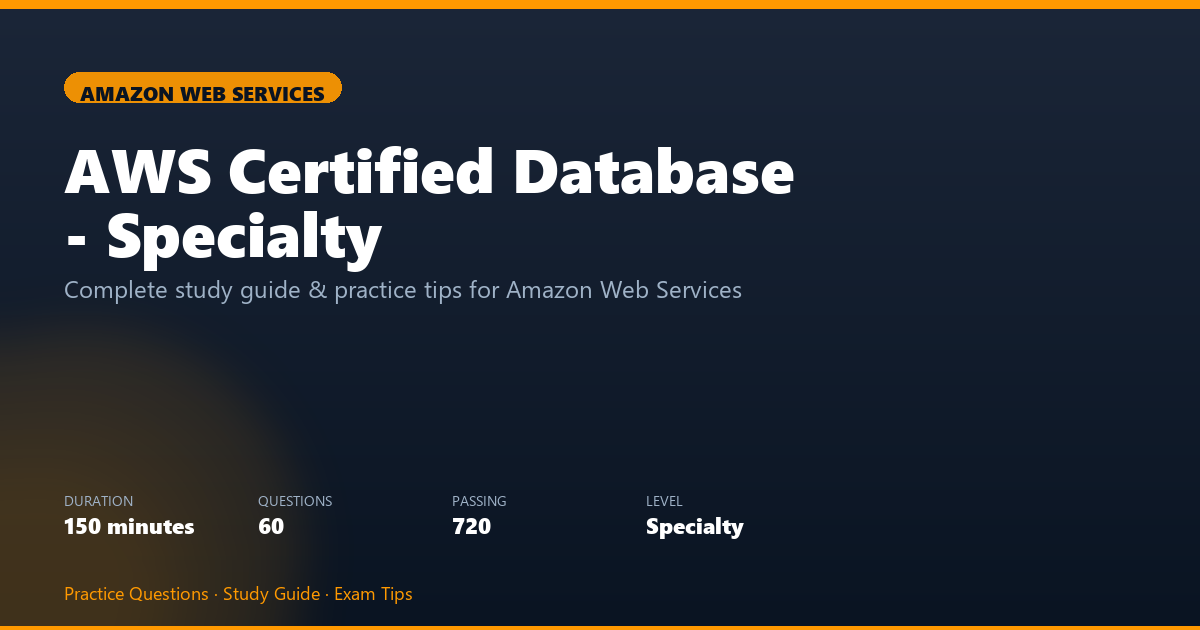
Detail Information Certification AWS Certified Database - Specialty Provider Amazon Web Services Exam Title AWS Certified Database - Specialty Duration 150 minutes Number of Questions 60 Passing Score 720 Exam Level Specialty Prerequisites Proficient in AWS services, with hands-on experience managing databases.
📑 Table of Contents
- AWS Certified Database - Specialty: Your Complete Guide to Passing the Exam
- What Is the AWS Certified Database - Specialty Certification?
- Exam Overview and Structure
- Key Topics Covered
- Study Tips and Preparation Strategy
- Common Challenges and How to Overcome Them
- Real-World Scenarios: How the Exam Thinks
- Why Practice Exams Matter â And How to Use Them Effectively
- Conclusion and Next Steps
AWS Certified Database - Specialty: Your Complete Guide to Passing the Exam
You've spent years tuning query plans, designing failover architectures, and explaining to stakeholders why "just add more indexes" isn't always the answer. You know databases inside and out â but the AWS Certified Database - Specialty exam doesn't reward general database knowledge alone. It rewards the ability to translate that expertise into AWS-native solutions: choosing between Aurora Global Database and cross-region read replicas, architecting DMS migration strategies that don't corrupt production, and knowing exactly when RDS Proxy beats a connection pool in your application tier.
If you're a database administrator, data engineer, solutions architect, or developer who lives at the intersection of data and cloud, this certification validates something employers genuinely need: the skill to design, operate, and secure database workloads on AWS at scale. This guide walks you through everything you need to know â from exam structure and core domains to study strategies, real-world scenarios, and how structured practice can mean the difference between a 710 and a confident pass.
What Is the AWS Certified Database - Specialty Certification?
The AWS Certified Database - Specialty is a role-based specialty certification from Amazon Web Services. Unlike the broad Solutions Architect or Developer Associate tracks, this exam goes deep on database-specific design patterns, operational best practices, and AWS database services.
| Attribute | Details |
|---|---|
| Certification Name | AWS Certified Database - Specialty |
| Provider | Amazon Web Services (AWS) |
| Level | Specialty |
| Prerequisites | Proficient in AWS services with hands-on experience managing databases |
| Validity | 3 years (retake the exam or recertify through AWS training and assessments) |
| Recommended Background | 5+ years of database experience, 2+ years on AWS |
This credential signals to employers and clients that you can:
- Select the right AWS database service for a given workload (OLTP, OLAP, key-value, graph, time-series, ledger)
- Design for high availability, disaster recovery, and cross-region resilience
- Implement security controls aligned with compliance requirements
- Optimize performance and cost without sacrificing reliability
- Plan and execute database migrations with minimal downtime
AWS positions this exam for professionals who "perform a database-focused role" â and the questions reflect that focus. Expect scenario-heavy items that assume you already understand AWS fundamentals and push you toward database-specific trade-offs.
Exam Overview and Structure
Understanding the exam format helps you manage time and expectations on test day.
| Exam Attribute | Specification |
|---|---|
| Exam Title | AWS Certified Database - Specialty |
| Duration | 150 minutes |
| Number of Questions | 60 scored questions (+ up to 15 unscored pilot questions) |
| Question Format | Multiple choice and multiple response |
| Passing Score | 720 out of 1000 (scaled score) |
| Delivery | Pearson VUE testing center or online proctored |
| Cost | $300 USD (as of 2026) |
How the Scoring Works
AWS uses a scaled scoring model, so you won't see a simple "X out of 60" result. The passing threshold of 720 is consistent across specialty exams, but individual questions carry different weights based on difficulty. You don't need a perfect score â but you do need consistent performance across all five domains, because weak spots in security or migration can drag down your overall result even if you ace performance tuning.
Time Management
With 150 minutes for 60+ questions, you have roughly 2.5 minutes per question â but some scenarios will take four or five minutes. Build a rhythm:
- First pass (90 minutes): Answer everything you're confident about; flag uncertain items
- Second pass (45 minutes): Revisit flagged questions with fresh context
- Final review (15 minutes): Sanity-check multiple-response selections and watch for absolute language ("always," "never")
Pilot questions are mixed in and indistinguishable from scored items, so treat every question seriously.
Key Topics Covered
The exam blueprint organizes content into five domains. While AWS may adjust weightings over time, the following reflects the current exam guide structure:
| Domain | Typical Weight | What You'll Be Tested On |
|---|---|---|
| Database Management | ~26% | Service selection, provisioning, monitoring, automation, backup strategies |
| Database Performance and Optimization | ~26% | Indexing, query tuning, caching, read/write scaling, storage optimization |
| Database Security | ~20% | IAM, encryption at rest/in transit, network isolation, auditing, Secrets Manager |
| Database High Availability and Disaster Recovery | ~16% | Multi-AZ, read replicas, global databases, backup/restore, RTO/RPO planning |
| Database Migration and Integration | ~12% | DMS, SCT, homogeneous vs. heterogeneous migration, ongoing replication |
Database Management
This domain tests whether you can match workloads to the right AWS service:
- Relational: Amazon RDS (MySQL, PostgreSQL, MariaDB, Oracle, SQL Server), Aurora (Standard and I/O-Optimized)
- NoSQL: DynamoDB, DocumentDB, Keyspaces (Cassandra-compatible)
- In-memory: ElastiCache (Redis, Memcached)
- Analytics/warehousing: Redshift, Redshift Serverless
- Specialty: Neptune (graph), Timestream (time-series), QLDB (ledger)
You'll need to know provisioning patterns, parameter groups, option groups, maintenance windows, and operational tooling like Performance Insights, Enhanced Monitoring, and CloudWatch alarms.
Database Performance and Optimization
Performance questions often present symptoms â elevated CPU, storage I/O credit exhaustion, connection saturation â and ask you to identify root cause and remediation. Key areas include:
- Aurora replica lag and cluster endpoint routing
- DynamoDB partition key design, hot partitions, and DAX caching
- RDS storage types (gp3, io2 Block Express) and IOPS provisioning
- Read replica promotion and connection handling during failover
- Query plan analysis using Performance Insights and native database tools
Database Security
Security items frequently combine multiple services. Expect scenarios involving:
- Encryption with AWS KMS (customer-managed vs. AWS-managed keys)
- VPC security groups, NACLs, and PrivateLink for database access
- IAM database authentication vs. traditional username/password
- Secrets Manager rotation for database credentials
- Audit logging (CloudTrail, database audit logs, VPC Flow Logs)
High Availability and Disaster Recovery
HA/DR scenarios test your ability to meet RTO and RPO requirements:
- Multi-AZ for synchronous failover within a region
- Cross-region read replicas and Aurora Global Database for DR
- Automated backups vs. manual snapshots (retention, cross-region copy)
- Route 53 health checks and DNS failover patterns
- Backup and restore procedures for point-in-time recovery
Database Migration and Integration
Migration is a smaller percentage of the exam but often trips up candidates who lack hands-on DMS experience:
- AWS Database Migration Service (DMS) for homogeneous and heterogeneous migrations
- Schema Conversion Tool (SCT) for converting Oracle/SQL Server schemas to PostgreSQL/Aurora
- Full load vs. CDC (Change Data Capture) replication
- Migration strategies: rehost, replatform, refactor
- Integration with S3, Kinesis, and Lambda for data pipelines
Study Tips and Preparation Strategy
Passing this exam requires more than reading documentation. Here's a structured approach that works for most candidates.
1. Start with the Official Exam Guide
Download the current AWS Certified Database - Specialty Exam Guide from AWS Training and Certification. Map each domain to your existing knowledge and honestly rate yourself. This gap analysis becomes your study plan.
2. Build Hands-On Labs
Reading about Aurora Global Database is not the same as creating one, adding a secondary region, and failing over. Minimum lab exercises:
- Launch RDS Multi-AZ and simulate failover; observe DNS endpoint behavior
- Create a DynamoDB table with poor partition key design, generate throttling, then fix it
- Run a DMS task replicating from on-premises MySQL (or RDS) to S3 in Parquet format
- Configure encryption at rest with a customer-managed KMS key and rotate it
AWS Free Tier covers many of these exercises. Budget $20â50 for a month of lab time if you go beyond free limits.
3. Study by Scenario, Not by Service
The exam presents problems, not flashcards. Organize notes around patterns:
- "I need sub-millisecond reads at millions of requests per second" â DynamoDB + DAX
- "I need PostgreSQL compatibility with serverless scaling" â Aurora Serverless v2
- "I need to migrate Oracle to PostgreSQL with minimal code changes" â DMS + SCT
4. Know the Limits and Quotas
AWS publishes service limits that appear in exam questions: maximum number of read replicas, DMS task limits, Aurora cluster sizes, DynamoDB item size limits. You don't need to memorize every number, but know the orders of magnitude and what happens when limits are exceeded.
5. Follow a 8â12 Week Timeline
| Phase | Duration | Focus |
|---|---|---|
| Foundation | Weeks 1â3 | Exam guide, AWS database whitepapers, core service documentation |
| Deep Dive | Weeks 4â7 | Domain-specific study, hands-on labs, re:Invent sessions on database topics |
| Practice | Weeks 8â10 | Timed practice exams, review weak domains |
| Final Review | Weeks 11â12 | Consolidate notes, light practice, rest before exam day |
Adjust based on your experience. Someone managing Aurora in production daily may compress this timeline; someone newer to AWS databases should extend it.
Common Challenges and How to Overcome Them
Challenge 1: Service Selection Paralysis
AWS offers overlapping database services, and exam questions exploit subtle differences. "We need a relational database with PostgreSQL compatibility, global read scaling, and fast cross-region disaster recovery" could point to Aurora Global Database â but add "with occasional SQL Server-specific T-SQL features" and the answer shifts.
Solution: Create comparison matrices for services that overlap (RDS vs. Aurora, DocumentDB vs. MongoDB compatibility, ElastiCache Redis vs. DynamoDB DAX). Focus on the differentiators AWS emphasizes: operational model, scaling dimensions, and migration paths.
Challenge 2: Underestimating Migration and Security
Many DBAs strong in performance tuning stumble on DMS task configuration or KMS encryption hierarchies because daily work doesn't expose them to these areas.
Solution: Dedicate specific study blocks to migration and security â don't treat them as "smaller domains I'll skim." Run at least two DMS labs: one homogeneous, one heterogeneous with SCT.
Challenge 3: Over-Engineering Answers
When you know architecture deeply, it's tempting to choose the most robust solution. The exam often rewards the simplest solution that meets all stated requirements â not the most impressive one.
Solution: Read every requirement twice. If the scenario specifies RPO of 24 hours and cost sensitivity, Aurora Global Database may be overkill compared to cross-region automated backup copy.
Real-World Scenarios: How the Exam Thinks
These scenarios mirror the style and complexity you'll encounter.
Scenario 1: E-Commerce Peak Traffic
A retail company runs Aurora PostgreSQL for its order management system. During annual sales events, read traffic spikes 10x while writes increase 3x. Connection counts from microservices exceed 5,000, causing too many connections errors. Latency SLAs require read responses under 50ms.
What the exam expects you to consider:
- RDS Proxy to pool and multiplex connections from microservices
- Aurora Replicas with reader endpoint for read scaling
- Caching layer (ElastiCache Redis) for session and catalog data
- Whether Aurora Serverless v2 fits the predictable spike pattern (usually reserved capacity with replicas is more cost-effective)
The wrong answer might add a larger instance without addressing connection pooling â fixing CPU while ignoring connection exhaustion.
Scenario 2: Regulated Financial Migration
A bank must migrate an on-premises Oracle database to AWS to reduce datacenter costs. Compliance requires encryption at rest with customer-managed keys, audit trails of all data access, and minimal downtime during cutover (under 30 minutes). The application cannot be rewritten immediately.
Relevant services and patterns:
- DMS with CDC for ongoing replication during cutover window
- SCT to assess and convert schema (though Oracle-specific features may require manual remediation)
- RDS for Oracle or migration to Aurora PostgreSQL depending on compatibility assessment
- KMS CMK for encryption, CloudTrail and database audit logs for compliance
- Cutover strategy: stop application writes, sync final CDC batch, validate, redirect DNS
Understanding homogeneous vs. heterogeneous migration paths â and when lift-and-shift to RDS Oracle beats replatforming â is essential.
Scenario 3: Global Gaming Leaderboard
A mobile gaming company needs a leaderboard storing player scores with sub-10ms read latency globally. Writes happen continuously; reads are frequent but eventually consistent scores are acceptable within seconds. Budget is a concern at scale.
Why this points to DynamoDB:
- Single-digit millisecond latency at scale with proper partition key design (e.g.,
gameIdas partition key,playerIdas sort key) - Global Tables for multi-region replication with eventual consistency
- DAX if microsecond caching is needed for top-N queries
- GSI/LSI design for querying top scores per game
The trap answer might suggest Aurora with read replicas â workable but harder to scale cost-effectively for this access pattern compared to DynamoDB.
Why Practice Exams Matter â And How to Use Them Effectively
Reading documentation and running labs builds knowledge. Practice exams build exam performance â and there's a meaningful difference. Many capable database professionals score below 720 on their first attempt because they haven't trained for the exam's specific format, pacing, and distractor design.
The Case for Timed Practice
Untimed study gives you unlimited space to reason through a question. The real exam gives you 150 minutes. Timed practice reveals:
- Whether you consistently overrun on migration scenarios
- If you're spending too long on early questions and rushing at the end
- How exam fatigue affects your judgment in the final 20 minutes
Treat timed practice exams as rehearsals, not assessments. Your first few scores matter less than the trend line â aim for stable scores above 750 before booking your exam slot.
Why Detailed Explanations Beat Question Volume Alone
Memorizing 500 questions without understanding why each wrong answer is wrong creates false confidence. High-quality practice materials provide:
- Explanation of the correct answer tied to AWS documentation concepts
- Analysis of each distractor â why it seems plausible but fails a requirement
- Reference to the underlying principle so you can generalize to unseen questions
When you miss a question about DMS task settings, the explanation should clarify full load vs. CDC, task dependencies, and table mappings â not just letter "C."
PDF Question Banks vs. Subscription Practice Platforms
Serious candidates benefit from using both formats as complementary tools:
| Format | Best For | Key Benefits |
|---|---|---|
| PDF-style question bank | Offline review, commute study, targeted domain drills | Portable, annotatable, repeatable review of weak areas without screen fatigue |
| Subscription practice exam bank | Full exam simulation, progress tracking, updated content | Timed modes, larger question pools, performance analytics by domain |
PDF question banks excel when you want to drill a single domain â say, 30 security questions during a lunch break â or revisit every question you missed the week before the exam. You control the pacing, can scribble notes in margins, and reinforce memory through spaced repetition without needing an internet connection.
Subscription-based practice exam platforms mirror the real testing experience more closely. Look for features that matter:
- Full-length 60-question exams with 150-minute timers
- Domain-level scoring breakdowns aligned to the five exam domains
- Regularly updated question sets reflecting new services and exam blueprint changes
- Detailed rationales for every option, not just the key
Using a structured question bank â whether PDF collections for offline study or a subscription platform for simulated exams â transforms passive reading into active retrieval practice, which cognitive science consistently shows improves long-term retention and exam performance.
A Practical Practice Routine
- After each study domain, complete 15â20 untimed questions with full explanation review
- Mid-study, take a half-length timed exam (30 questions, 75 minutes) to check pacing
- Two weeks before exam day, take two full-length timed practice exams on separate days
- Final week, review every missed question from all practice sessions â no new material
- Day before, light review only; trust your preparation
If your practice scores plateau in the 680â700 range, resist booking the exam hoping for luck. Identify weak domains from your breakdown reports, lab those services, then retest.
Conclusion and Next Steps
The AWS Certified Database - Specialty exam is one of the most respected credentials for cloud database professionals. It validates that you can do more than administer a database â you can architect resilient, secure, performant data platforms on AWS and navigate the real trade-offs employers face daily.
Your path to a passing score of 720+ comes down to three pillars:
- Hands-on fluency with Aurora, RDS, DynamoDB, DMS, and the supporting ecosystem (KMS, VPC, CloudWatch, Secrets Manager)
- Scenario-based thinking that matches requirements to the simplest adequate AWS solution
- Deliberate practice under exam conditions, with detailed feedback on every question you miss
Start by downloading the official exam guide and honestly assessing your gaps across all five domains â not just the ones where you're strongest. Build labs that scare you a little. Pair that foundation with a rigorous practice routine: use PDF question banks for focused offline review and a subscription practice exam bank for full timed simulations and domain-level progress tracking. Together, those tools close the gap between knowing AWS databases and proving it under pressure.
When your practice exams consistently score above 750 and you can explain why every wrong answer is wrong, you're ready. Schedule your exam, get a good night's sleep beforehand, and walk in confident that your preparation matches the credential's rigor.
Your next steps:
- Download the AWS Certified Database - Specialty Exam Guide
- Complete a self-assessment against all five domains
- Set up at least three hands-on labs (Aurora failover, DynamoDB design, DMS migration)
- Begin daily practice questions with detailed explanation review
- Schedule a full-length timed practice exam within your first month of study
- Book your exam date once practice scores consistently exceed 750
The database specialty credential doesn't come easily â and that's exactly why it's worth earning.
Pass the exam with our practice question bank
Timed multiple-choice practice is one of the fastest ways to close knowledge gaps before test day. Use our PDF question banks for offline review and subscribe to the practice exam question bank for full access to realistic items, explanations, and a study flow aligned to the official blueprint.
- Question bank scope: Prep coverage tied to AWS Certified Database - Specialty draws from a curated pool of 60 discussion-grounded practice prompts aligned to the blueprint (totals reflect the dataset backing this guide).
- Learner benchmarks: 94% — Students found the real exam almost same
- Learner benchmarks: 1057 — Students passed this exam after ExamTopic Prep
Start practicing for this exam
Disclaimer: This blog post is for educational purposes only. Certification exam details may change over time. Always refer to the official certification provider for the most up-to-date information.
Comments
No comments yet. Be the first to share your thoughts.