![AWS Certified Developer Associate Exam Guide: Complete Preparation for AWS Certified Developer Associate [2026]](/_next/image?url=https%3A%2F%2Fstorage.googleapis.com%2Fdevcopublich%2Fblog-covers%2Famazon%2FAWS%20Certified%20Developer%20Associate%2Faws-certified-developer-associate_cover.png&w=3840&q=75)
📋 Exam Quick Facts
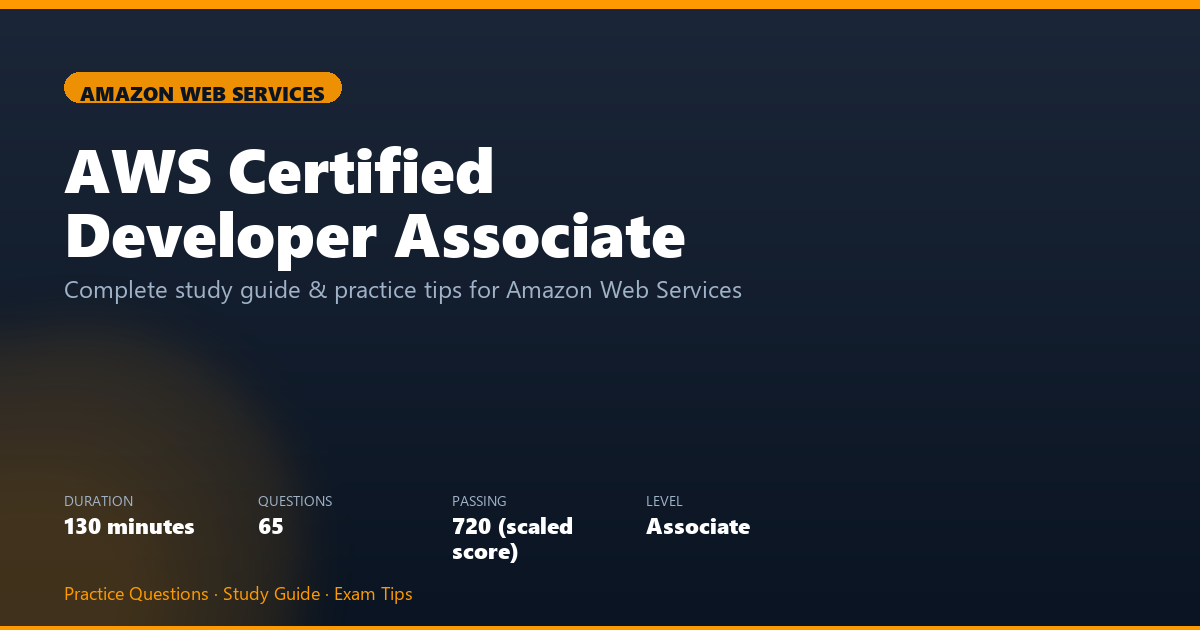
Detail Information Certification AWS Certified Developer Associate Provider Amazon Web Services Exam Title AWS Certified Developer Associate Duration 130 minutes Number of Questions 65 Passing Score 720 (scaled score) Exam Level Associate Prerequisites Candidates should have one or more years of hands-on experience developing and maintaining an AWS-based application, along with in-depth knowledge of at least one high-level programming language.
📑 Table of Contents
- AWS Certified Developer Associate: Your Complete Guide to Passing the Exam
AWS Certified Developer Associate: Your Complete Guide to Passing the Exam
You deploy a Lambda function that works flawlessly in your dev account. In production, it times out on cold starts, can't reach a private RDS instance, and CloudWatch shows permission errors you never saw locally. Sound familiar? That gap between "it works on my machine" and "it runs reliably in AWS" is exactly what the AWS Certified Developer Associate exam measuresâand why earning this credential matters for developers who build on the cloud.
Whether you're aiming for your first AWS certification or sharpening skills you've picked up on the job, this guide walks you through what the exam covers, how to prepare effectively, and how to avoid the pitfalls that trip up even experienced engineers.
What Is the AWS Certified Developer Associate Certification?
The AWS Certified Developer â Associate is an industry-recognized credential from Amazon Web Services. It validates that you can design, deploy, debug, and maintain cloud-native applications using core AWS servicesânot just that you've read documentation, but that you understand how services interact under real constraints.
| Attribute | Details |
|---|---|
| Certification name | AWS Certified Developer Associate |
| Provider | Amazon Web Services (AWS) |
| Level | Associate |
| Prerequisites | One or more years of hands-on experience developing and maintaining AWS-based applications, plus in-depth knowledge of at least one high-level programming language |
| Validity | 3 years |
| Renewal | Pass the current version of this exam or a higher-level AWS certification exam |
Unlike entry-level cloud badges, this exam assumes you've shipped code that talks to S3, DynamoDB, Lambda, or API Gateway. It rewards practical judgment: choosing the right deployment pattern, securing credentials correctly, and knowing when to refactor versus when to add another service.
For hiring managers, the certification signals you can contribute on day one to serverless pipelines, CI/CD workflows, and production troubleshooting. For you, it's a structured map of the skills that separate hobby projects from production-grade AWS applications.
Exam Overview and Structure
Understanding the exam format helps you manage time and expectations before test day.
| Exam attribute | Specification |
|---|---|
| Exam title | AWS Certified Developer Associate |
| Duration | 130 minutes |
| Number of questions | 65 |
| Question format | Multiple choice and multiple response |
| Passing score | 720 (on a scaled score of 100â1000) |
| Delivery | Pearson VUE testing center or online proctored exam |
You have roughly two minutes per question, but some scenarios will take longer. AWS exams often present a short case studyâa architecture diagram described in textâfollowed by several questions about that setup. Budget time accordingly: if a question stumps you, flag it and move on.
Questions fall into five official domains:
| Domain | Weight (approximate) |
|---|---|
| Deployment | ~24% |
| Security | ~26% |
| Development with AWS Services | ~30% |
| Refactoring, Monitoring, and Troubleshooting | ~20% |
The exam is scenario-heavy. Expect prompts like: "A developer needs to reduce Lambda latency when reading from DynamoDB" or "An application must enforce least-privilege access for a cross-account S3 bucket." Pure memorization of service limits won't carry you; you need to reason through trade-offs.
Key Topics Covered
Below is a practical breakdown of what each domain expects you to knowânot an exhaustive syllabus, but the concepts that appear repeatedly.
Deployment (~24%)
- CI/CD on AWS: CodePipeline, CodeBuild, CodeDeploy, and how they integrate with Git-based workflows
- Infrastructure as Code: CloudFormation and AWS SAM for serverless; understanding stacks, parameters, and drift
- Deployment strategies: Blue/green, rolling, and canary deployments for Lambda and EC2
- Elastic Beanstalk and container basics: When each fits versus raw Lambda or ECS
- Environment management: Dev/staging/prod separation, parameter stores, and secrets handling during deploys
Security (~26%)
- IAM: Roles vs. users vs. policies; resource-based policies; permission boundaries; cross-account access
- Encryption: KMS, encryption at rest and in transit, client-side vs. server-side encryption for S3
- Secrets: Secrets Manager and Systems Manager Parameter Store (SecureString)
- Authentication and authorization: Cognito user pools and identity pools, API Gateway authorizers, OAuth/OIDC flows at a conceptual level
- Compliance patterns: VPC endpoints, security groups vs. NACLs for service-to-service communication
Development with AWS Services (~30%)
This is the largest slice and the heart of the developer role:
- Compute: Lambda (handlers, layers, concurrency, destinations, event sources), ECS/Fargate basics
- APIs: API Gateway (REST vs. HTTP APIs), request/validation mapping, throttling, caching
- Data stores: DynamoDB (partition keys, GSIs, streams, TTL), S3 (versioning, lifecycle, event notifications), ElastiCache use cases
- Messaging and events: SQS (standard vs. FIFO), SNS, EventBridge rules and patterns
- SDKs and CLI: Boto3 patterns, credential provider chains, exponential backoff and idempotency
Refactoring, Monitoring, and Troubleshooting (~20%)
- Observability: CloudWatch Logs, Metrics, Alarms, X-Ray tracing for distributed requests
- Performance: Right-sizing Lambda memory, DynamoDB capacity modes, S3 transfer optimization
- Debugging: Interpreting error messages (AccessDenied, throttling, timeout), using CloudWatch Insights
- Refactoring: Moving from monolith to microservices, introducing queues for decoupling, migrating to serverless where it makes sense
Study Tips and Preparation Strategy
A focused plan beats random video binging. Here's a structure that works for most candidates with six to ten weeks of part-time study.
Phase 1: Map the domains (Week 1â2)
- Skim the official exam guide and align your weak spots with domain weights.
- Build a personal lab account (Free Tier helps). Avoid using your employer's production account for experiments.
- Complete at least one end-to-end project: e.g., API Gateway â Lambda â DynamoDB with CI/CD via CodePipeline.
Phase 2: Hands-on depth (Week 3â5)
- Implement IAM roles for Lambda accessing S3 and DynamoDBânever hard-code keys.
- Trigger Lambda from S3 events, SQS, and DynamoDB Streams; note payload shapes and failure handling (DLQs).
- Deploy the same app with CloudFormation or SAM and tear it down cleanly.
- Enable X-Ray on a multi-service flow and trace a single request.
Phase 3: Exam conditioning (Week 6+)
- Take timed practice exams weekly (see Section 7).
- Review every wrong answer; write a one-line "lesson learned" note.
- Two days before the exam, light review onlyâno marathon cramming.
Practical tips that save points on exam day
| Tip | Why it matters |
|---|---|
| Learn IAM policy JSON syntax | Many questions show a policy and ask what's allowed or denied |
| Know SQS vs. SNS vs. EventBridge | Picking the wrong messaging pattern is a common wrong answer |
| Understand DynamoDB key design | Hot partitions and GSI projection types appear often |
| Practice reading CloudFormation/SAM snippets | You don't write full templates from scratch, but you interpret them |
| Master the Well-Architected Serverless Lens themes | Security, reliability, and cost map directly to scenario questions |
Common Challenges and How to Overcome Them
Challenge 1: Confusing similar services
SQS vs. SNS vs. EventBridge, Secrets Manager vs. Parameter Store, REST API vs. HTTP API in API GatewayâAWS offers overlapping tools, and the exam tests whether you know the right tool for a requirement.
Fix: Create a comparison table for each pair. For every service, note one sentence: "Use this whenâ¦"
Challenge 2: IAM depth
Candidates underestimate how granular IAM gets: condition keys, resource ARNs, explicit Deny, and cross-account bucket policies.
Fix: In your lab, deliberately break permissions and fix AccessDenied errors. Read the error message and the policy simulator output until the logic clicks.
Challenge 3: Time pressure on long scenarios
Multi-question scenarios can burn fifteen minutes if you're not careful.
Fix: During practice exams, enforce the 130-minute limit strictly. Develop a rhythm: read the scenario once, answer what you can, flag the rest.
Real-world scenario: The production deployment gone wrong
Your team uses CodePipeline to deploy a Node.js Lambda behind API Gateway. After a Friday deploy, error rates spike. CloudWatch shows Task timed out after 3.00 seconds. The developer increased timeout to 30 seconds without investigating. Latency improves slightly but costs jump.
Exam-relevant lesson: The Developer Associate exam expects you to identify root causesâperhaps a missing VPC endpoint causing slow ENI setup, or a cold start plus synchronous RDS callânot just to tweak timeouts. Monitoring, X-Ray, and architectural refactoring domains all apply here.
Real-world scenario: Least privilege in a shared account
A junior developer attaches AdministratorAccess to a Lambda execution role "to get things working." An S3 bucket with customer uploads is later scraped after credentials leak from environment variables in a public repo.
Exam-relevant lesson: Security domain questions push you toward IAM roles, resource-based policies, and Secrets Managerânever long-lived keys in code. You should recognize why s3:GetObject scoped to a bucket ARN beats a broad managed policy.
Real-world scenario: DynamoDB throttling under load
A flash sale doubles traffic to your checkout API. DynamoDB returns ProvisionedThroughputExceededException despite "plenty of capacity" on the main table.
Exam-relevant lesson: The bottleneck might be a GSI with insufficient write capacity, or you need on-demand billing / auto scaling. Development and troubleshooting domains converge on understanding partition keys, burst behavior, and how streams fan out work.
Why Practice Exams Matter: Timed Runs, Explanations, and a Structured Question Bank
Reading guides and watching tutorials builds familiarityâbut passing the Developer Associate exam requires exam-specific conditioning. Here's why deliberate practice with a quality question bank should be central to your prep.
Timed practice mirrors real pressure
The 130-minute ceiling is unforgiving. Untimed quizzes build knowledge; timed simulations build the pacing and decision-making you'll need when question 40 arrives and you've used half your clock. Regular timed runs teach you when to commit to an answer versus when to flag and return. That muscle memory is difficult to develop from flashcards alone.
Detailed explanations turn misses into mastery
A score alone tells you that you failed; a strong explanation tells you why the correct answer wins and why your choice seemed plausible. The best practice materials walk through:
- Why a specific IAM policy grants or denies access
- Why FIFO SQS fits ordering requirements that standard queues cannot
- How a CloudFormation snippet would behave on stack update
After each practice session, treat wrong answers as a mini-lesson. Candidates who review explanations thoroughly often report that the same concept never tricks them twice.
A structured question bank aligns with exam domains
Random questions from forum threads scatter your attention. A structured bank organized by Deployment, Security, Development, and Refactoring/Monitoring lets you:
- Drill weak domains intentionally
- Track improvement over multiple attempts
- Avoid gaps where you've accidentally over-studied Lambda but under-studied CodeDeploy
Look for banks that map questions to official domains and difficulty levels, so your study time follows the exam's weightingsânot whatever topic happened to trend on social media that week.
PDF-style question banks vs. subscription practice platforms
Both formats serve different moments in your study calendar:
| Format | Best for | Key benefit |
|---|---|---|
| PDF-style question bank | Commute reading, offline review, annotating tricky scenarios | Portable repetition; mark questions to revisit; simulate "flash review" before bed |
| Subscription practice exam bank | Full timed mocks, score tracking, rotating fresh sets | Simulates Pearson VUE conditions; prevents memorizing answers; supports repeated full-length attempts |
A PDF-style collection excels when you want to work through scenario questions on a tablet, highlight IAM policies, and revisit missed items without an internet connection. It's ideal for targeted review: "This week, only Security domain, 20 questions per night."
A subscription practice exam platform shines in the final weeks. You sit full 65-question, 130-minute exams, review aggregated weak areas, and retake new or shuffled sets so you're proving understandingânot recalling letter patterns from the last attempt.
Used together, they cover both depth (slow, analytical review) and exam readiness (timed endurance and score trend).
How to get the most from practice exams
- Simulate test conditions: Quiet room, no notes, strict timer.
- Score on a curve mentally: Many quality banks aim for difficulty at or slightly above the real exam; low first scores are normal.
- Maintain an error log: Service, domain, one-sentence root cause.
- Retake after hands-on labs: If DynamoDB questions keep missing, build a GSI-heavy lab, then retest that domain.
- Schedule your last full mock 5â7 days before the real examâenough time to patch gaps, not so close that panic sets in.
When you're ready to add structured practice to your plan, use a dedicated AWS Certified Developer Associate question bank and timed mock exams as part of your routineâthe same way marathon runners do long runs before race day. Your published study guide will include an official practice resource link; treat full-length mocks as non-optional if you want to walk in confident rather than hopeful.
Conclusion and Next Steps
The AWS Certified Developer Associate exam is a rigorous, practical test of how well you build and operate applications on AWS. It rewards developers who understand deployment pipelines, secure defaults, core services, and how to refactor and observe systems under loadânot those who've merely clicked through the console once or twice.
Your action plan:
- Confirm eligibility: Ensure you have the recommended year-plus of hands-on AWS development experience (or get close through intensive lab work).
- Audit your skills against the five domains and prioritize Development and Securityâthey combine for more than half the exam.
- Build one realistic project with CI/CD, IAM roles, DynamoDB or S3, and CloudWatch/X-Ray observability.
- Integrate practice exams early, not the night before: use PDF-style banks for domain drills and subscription timed mocks for pacing and readiness.
- Schedule the exam when two consecutive timed practice scores sit comfortably in passing territory and your error log shows patterns, not surprises.
- Plan renewal: Remember the credential is valid for three years; stay current via recertification or a higher-level AWS exam.
The gap between a developer who uses AWS and a developer who understands AWS is measurableâand for many, this certification is the proof. Start with honest self-assessment, invest in hands-on reps, and let structured practice exams sharpen the judgment that scenario questions demand. Pass the exam, and you'll have more than a badge: you'll have a production-minded mindset that pays off on every deploy, incident, and design review afterward.
Pass the exam with our practice question bank
Timed multiple-choice practice is one of the fastest ways to close knowledge gaps before test day. Use our PDF question banks for offline review and subscribe to the practice exam question bank for full access to realistic items, explanations, and a study flow aligned to the official blueprint.
- Question bank scope: Prep coverage tied to AWS Certified Developer Associate draws from a curated pool of 65 discussion-grounded practice prompts aligned to the blueprint (totals reflect the dataset backing this guide).
- Learner benchmarks: 94% — Students found the real exam almost same
- Learner benchmarks: 1057 — Students passed this exam after ExamTopic Prep
Start practicing for this exam
Disclaimer: This blog post is for educational purposes only. Certification exam details may change over time. Always refer to the official certification provider for the most up-to-date information.
Comments
No comments yet. Be the first to share your thoughts.