![AWS Certified Advanced Networking - Specialty ANS-C01 Exam Guide: Complete Preparation for AWS Certified Advanced Networking - Specialty ANS-C01 [2026]](/_next/image?url=https%3A%2F%2Fstorage.googleapis.com%2Fdevcopublich%2Fblog-covers%2Famazon%2FAWS%20Certified%20Advanced%20Networking%20-%20Specialty%20ANS-C01%2Faws-certified-advanced-networking-specialty-ans-c01_cover.png&w=3840&q=75)
📋 Exam Quick Facts
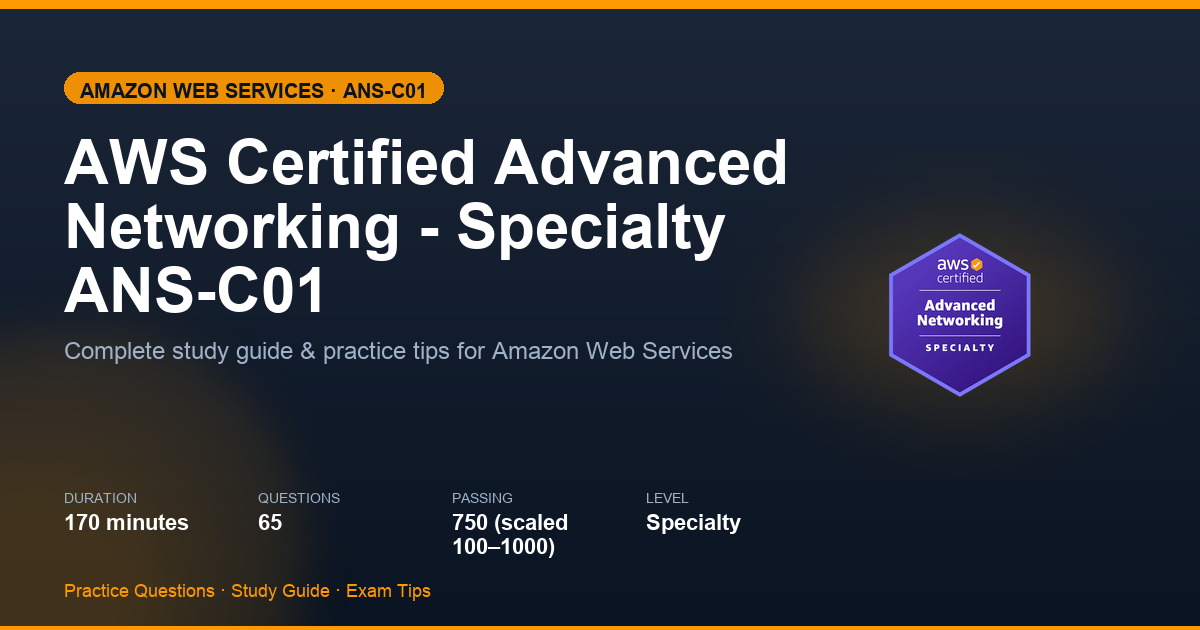
Detail Information Certification AWS Certified Advanced Networking - Specialty ANS-C01 Provider Amazon Web Services Exam Title AWS Certified Advanced Networking - Specialty ANS-C01 Duration 170 minutes Number of Questions 65 Passing Score 750 (scaled 100–1000) Exam Level Specialty Prerequisites Five or more years of hands-on experience designing and implementing complex network architectures, with at least two years specifically on AWS.
📑 Table of Contents
- AWS Certified Advanced Networking â Specialty (ANS-C01): Your Complete Exam Guide
- What Is the AWS Certified Advanced Networking â Specialty (ANS-C01)?
- Exam Overview and Structure
- Key Topics Covered
- Study Tips and Preparation Strategy
- Common Challenges and How to Overcome Them
- Real-World Scenarios You Should Understand
- Practice Exam Importance: Train the Way Youâll Be Tested
- Conclusion and Next Steps
AWS Certified Advanced Networking â Specialty (ANS-C01): Your Complete Exam Guide
Youâve built VPCs, tuned BGP, and debugged asymmetric routing at 2 a.m. You know networking â but the AWS Certified Advanced Networking â Specialty (ANS-C01) exam asks something harder: can you design, secure, and operate enterprise-grade networks inside AWSâs shared responsibility model, at scale, under exam pressure?
This guide breaks down what ANS-C01 actually tests, how to prepare efficiently, and how to turn deep experience into a passing score.
What Is the AWS Certified Advanced Networking â Specialty (ANS-C01)?
The AWS Certified Advanced Networking â Specialty (ANS-C01) is AWSâs expert-level networking certification. It validates that you can design, implement, and manage complex hybrid and multi-account network architectures on AWS â not just configure subnets and security groups.
Unlike the Solutions Architect or SysOps tracks, ANS-C01 goes deep on:
- Layer 3/4 connectivity (Transit Gateway, Direct Connect, VPN, BGP)
- Advanced routing and traffic engineering
- Network security at scale (firewalls, inspection, segmentation)
- Observability, automation, and operational excellence
| Attribute | Details |
|---|---|
| Certification name | AWS Certified Advanced Networking â Specialty (ANS-C01) |
| Provider | Amazon Web Services |
| Level | Specialty |
| Prerequisites (recommended) | 5+ years designing/implementing complex networks; 2+ years on AWS |
| Validity | 3 years |
| Recertification | Pass the current ANS-C01 exam or a relevant higher-level certification |
AWS positions this cert for senior network engineers, cloud architects, and security-focused engineers who own connectivity, segmentation, and compliance for production workloads.
Exam Overview and Structure
Understanding the exam format helps you manage time and expectations.
| Exam attribute | Value |
|---|---|
| Exam code | ANS-C01 |
| Duration | 170 minutes |
| Number of questions | 65 |
| Question types | Multiple choice and multiple response |
| Passing score | 750 (scaled 100â1000) |
| Delivery | Pearson VUE testing center or online proctored |
You have roughly 2.6 minutes per question â enough if you know the material, tight if youâre still reasoning through fundamentals on exam day.
How AWS weights the domains
ANS-C01 is organized into five domains. Treat these percentages as your study budget:
| Domain | Weight | What it really means |
|---|---|---|
| Network Design | 30% | Architecture choices: hybrid, multi-VPC, multi-account, HA, cost vs. performance |
| Network Implementation | 26% | Building it: TGW, DX, VPN, PrivateLink, Route 53, IPv6, automation |
| Network Management and Operation | 20% | Monitoring, troubleshooting, flow logs, Network Manager, incident response |
| Network Security, Compliance, and Governance | 24% | Segmentation, inspection, encryption, IAM/network policy, compliance patterns |
Design and Implementation together are more than half the exam. If you only study console clicks without architectural trade-offs, youâll feel underprepared.
Scoring and question style
AWS uses scaled scoring; you donât need a perfect score. Some questions are unscored pilot items â you wonât know which. Multiple-response questions require all correct choices; partial credit isnât awarded.
Expect scenario-heavy questions: a company with 40 accounts, strict compliance, and a mandate to reduce NAT costs â pick the design that meets all constraints, not the one that sounds most familiar.
Key Topics Covered
Below are high-yield areas that appear repeatedly, mapped to real exam thinking.
Network Design (30%)
- Hybrid connectivity: Site-to-Site VPN vs. Direct Connect vs. both; DX resiliency (dual connections, diverse paths)
- Multi-VPC architecture: Transit Gateway route tables, segment isolation, east-west vs. north-south traffic
- Multi-account networking: AWS Organizations, shared services VPC, centralized egress/ingress
- DNS strategy: Route 53 Resolver rules, hybrid DNS, split-horizon
- IPv6: Dual-stack design, egress-only IGW, IPv6 security implications
- Cost and performance: NAT Gateway placement, TGW vs. VPC peering at scale, data transfer awareness
Network Implementation (26%)
- Transit Gateway: Attachments, route propagation, blackhole routes, inter-region peering
- Direct Connect: VIF types (private/public/transit), DX Gateway, MACsec, LAG
- VPN: Accelerated VPN, tunnel options, BGP vs. static, HA patterns
- PrivateLink & endpoints: Interface vs. gateway endpoints, endpoint policies
- Load balancing: NLB/ALB/GLB use cases, cross-zone behavior, static IP needs
- Infrastructure as Code: CloudFormation/Terraform patterns for repeatable network builds
Network Management and Operation (20%)
- VPC Flow Logs, Traffic Mirroring, Reachability Analyzer
- AWS Network Manager: topology, telemetry, route analysis
- Troubleshooting: asymmetric routing, security group vs. NACL vs. route table, MTU/MSS issues
- Automation: EventBridge, Lambda for network remediation, Systems Manager
Network Security, Compliance, and Governance (24%)
- Segmentation: micro-segmentation with security groups, NACLs, Network Firewall
- Inspection architectures: centralized vs. distributed, GWLB with third-party appliances
- Encryption: TLS, IPsec, MACsec on DX, KMS integration
- Compliance: PCI, HIPAA-style patterns (network controls, logging, least privilege)
- Governance: AWS Network Firewall policies, AWS Config rules, SCPs affecting networking
Study Tips and Preparation Strategy
A structured plan beats random documentation reading. Hereâs a practical approach used by successful candidates.
Phase 1: Baseline and gap analysis (Week 1)
- Skim the official ANS-C01 exam guide and mark unknown services.
- Take a diagnostic practice exam under timed conditions â not to pass, but to expose weak domains.
- Map your day job to the five domains; gaps in your job often become gaps on the exam.
Phase 2: Deep study by domain (Weeks 2â6)
| Week focus | Activities |
|---|---|
| Design + Implementation | Whitepapers, Workshop labs, build a multi-account TGW lab |
| Security + Governance | Network Firewall, GWLB, endpoint policies, Organizations SCPs |
| Operations | Break things intentionally: wrong route tables, BGP ASN conflicts, flow log analysis |
Hands-on labs are non-negotiable. ANS-C01 rewards candidates whoâve seen failure modes â blackhole routes, DX failover quirks, Resolver forwarding edge cases.
Phase 3: Integration and exam readiness (Weeks 7â8)
- Mix domain questions (not single-topic drills only).
- Review AWS Well-Architected networking pillars and the Security Pillar.
- Memorize decision frameworks, not trivia: when TGW beats peering, when PrivateLink beats VPC endpoints, when DX beats VPN.
Daily habits that compound
- Draw diagrams for every practice question â 60 seconds of sketching often clarifies the answer.
- Read distractors carefully â ANS-C01 wrong answers are often partially correct designs that fail one requirement.
- Track an âerror logâ â document why you missed each question; patterns emerge quickly.
Common Challenges and How to Overcome Them
Challenge 1: âI know networking, but not AWS-native patternsâ
Symptom: Strong CCNP/JNCIE background, but unsure about PrivateLink, GWLB, or TGW route table behavior.
Fix: Translate familiar concepts into AWS terms. Your DMZ becomes a centralized inspection VPC; your MPLS handoff becomes Direct Connect with BGP over private VIF. Build one hybrid lab and break routing deliberately.
Challenge 2: Overwhelming service breadth
Symptom: Studying Route 53 Resolver one day, MACsec the next â nothing sticks.
Fix: Organize by traffic flows (on-premises â AWS â internet â SaaS) instead of alphabetical services. Each flow touches design, implementation, security, and operations â mirroring the exam.
Challenge 3: Scenario questions with competing requirements
Symptom: Two answers look valid; you pick the cheaper one when the question emphasized compliance.
Fix: Underline constraints in the stem: lowest latency, least operational overhead, highest security, lowest data transfer cost. AWS tags one as the primary optimizer â match that.
Real-World Scenarios You Should Understand
These mirror the complexity ANS-C01 expects you to handle.
Scenario 1: Multi-account retail platform with centralized egress
A retailer runs 30 AWS accounts under Organizations. Each account has workloads in private subnets. Security mandates consistent egress filtering, domain allowlisting, and no direct internet from spoke VPCs.
Exam-relevant design: Shared services VPC with AWS Network Firewall or third-party appliances via Gateway Load Balancer, Transit Gateway hub-spoke topology, default route to inspection VPC, Route 53 Resolver rules for DNS logging, and SCPs preventing IGW attachment in spoke accounts.
Trap to avoid: NAT Gateway in every account without centralized inspection â simpler, but fails governance requirements.
Scenario 2: Hybrid manufacturing with Direct Connect and low-latency OT traffic
A factory sends telemetry from on-premises OT systems to AWS analytics. Requires consistent 5 msâlevel latency, encrypted transit, and resilient connectivity.
Exam-relevant design: Dual Direct Connect connections to diverse locations, DX Gateway + Transit Gateway, BGP with appropriate ASN planning, MACsec where supported, accelerated Site-to-Site VPN as backup (understanding bandwidth/limit trade-offs), and Placement of workloads in the Region closest to the DX location.
Trap to avoid: VPN-only design when the scenario specifies dedicated, predictable throughput and strict latency â DX is usually the anchor.
Scenario 3: SaaS provider offering private connectivity to enterprise customers
A SaaS platform on AWS must let customers access the application without traversing the public internet, from their VPCs and from on-premises.
Exam-relevant design: AWS PrivateLink (interface endpoint service) for customer VPC access, Direct Connect or VPN integration for on-premises via PrivateLink Gateway or hybrid DNS considerations, NLB behind the endpoint service, and endpoint policies for tenant isolation.
Trap to avoid: Public ALB with IP allowlisting â fragile, doesnât meet âno public internetâ requirements.
Practice Exam Importance: Train the Way Youâll Be Tested
Reading whitepapers builds knowledge; practice exams build exam performance. For ANS-C01, theyâre not optional â theyâre how you convert expertise into a 750+ score.
Why timed practice matters
Untimed study creates false confidence. Under exam conditions, you must:
- Process long scenario stems quickly
- Eliminate plausible distractors
- Manage 170 minutes across 65 questions with mental stamina
Timed practice teaches pace calibration: when to commit, when to flag and move on, and how to avoid spending five minutes on a single BGP nuance while easier points remain on the table.
Why detailed explanations matter
A score alone tells you that you failed Network Security â explanations tell you why:
- You confused security group statefulness with NACL directionality
- You picked VPC peering when Transit Gateway was required for transitive routing
- You missed that endpoint policies were the isolation mechanism, not IAM alone
High-quality explanations link each question back to AWS documentation and architectural principles. That feedback loop is how missed questions become permanent knowledge â especially for services you donât use daily at work.
Why a structured question bank matters
Random free questions scattered across the web create coverage gaps and duplicate easy topics. A structured bank aligned to ANS-C01 domains ensures you:
- Hit all five domains in proportion to exam weight
- Revisit weak areas systematically
- Exposure yourself to varied scenario templates (multi-account, hybrid, compliance-driven)
PDF-style question banks excel for focused review: offline access on a commute, printable sets for annotation, and the ability to circle keywords in scenario stems the way you should on exam day. Use them for domain sprints â e.g., 20 Design questions with diagram sketches before checking answers.
A subscription practice exam bank adds dynamic value: full-length timed simulations, updated questions as AWS evolves services, performance dashboards by domain, and repeated full exams without memorizing the same 65 questions. Together, PDF banks and subscription exams cover depth (topic drills) and breadth (realistic full runs).
| Prep resource | Best for | Limitation if used alone |
|---|---|---|
| Documentation & labs | Foundational understanding | Doesnât train exam pacing or distractor analysis |
| PDF question bank | Offline review, domain-focused drills | Static; may lack full-exam simulation |
| Subscription practice exams | Timed runs, analytics, fresh question sets | Should be paired with hands-on labs |
| Official AWS practice materials | Exam tone calibration | Limited question volume |
Recommended rhythm: labs during the week â domain question sets on weekends â one full timed practice exam every 7â10 days in the final month â error log review after every session.
Conclusion and Next Steps
The AWS Certified Advanced Networking â Specialty (ANS-C01) exam is demanding because it tests judgment, not memorization. Success means connecting hybrid connectivity, multi-account governance, security inspection, and operational troubleshooting into coherent designs â often when multiple âgoodâ answers compete.
Your path forward:
- Audit your gaps against the five official domains.
- Build (and break) at least one lab covering TGW, hybrid connectivity, and centralized security.
- Integrate practice exams early â timed, explained, and aligned to domain weights.
- Maintain an error log and revisit weak domains until practice scores consistently exceed your target buffer (many candidates aim for ~80%+ on full practice exams before booking).
- Schedule the exam when timed practice shows stable performance across all domains â not when youâve merely finished reading.
If youâre ready to move from âI work with AWS networkingâ to âIâm certified at the highest AWS networking level,â start with one honest diagnostic practice exam this week. The results will tell you exactly where the next 30 days of study should go â and that clarity is worth more than another passive hour of documentation reading.
Disclaimer: AWS, Amazon Web Services, and related marks are trademarks of Amazon.com, Inc. or its affiliates. This guide is independent exam preparation content and is not affiliated with or endorsed by AWS.
Pass the exam with our practice question bank
Timed multiple-choice practice is one of the fastest ways to close knowledge gaps before test day. Use our PDF question banks for offline review and subscribe to the practice exam question bank for full access to realistic items, explanations, and a study flow aligned to the official blueprint.
- Question bank scope: Prep coverage tied to AWS Certified Advanced Networking - Specialty ANS-C01 draws from a curated pool of 65 discussion-grounded practice prompts aligned to the blueprint (totals reflect the dataset backing this guide).
- Learner benchmarks: 94% — Students found the real exam almost same
- Learner benchmarks: 1057 — Students passed this exam after ExamTopic Prep
Start practicing for this exam
Disclaimer: This blog post is for educational purposes only. Certification exam details may change over time. Always refer to the official certification provider for the most up-to-date information.
Comments
No comments yet. Be the first to share your thoughts.