![AWS Certified DevOps Engineer - Professional DOP-C02 Exam Guide: Complete Preparation for AWS Certified DevOps Engineer - Professional DOP-C02 [2026]](/_next/image?url=https%3A%2F%2Fstorage.googleapis.com%2Fdevcopublich%2Fblog-covers%2Famazon%2FAWS%20Certified%20DevOps%20Engineer%20-%20Professional%20DOP-C02%2Faws-certified-devops-engineer-professional-dop-c02_cover.png&w=3840&q=75)
📋 Exam Quick Facts
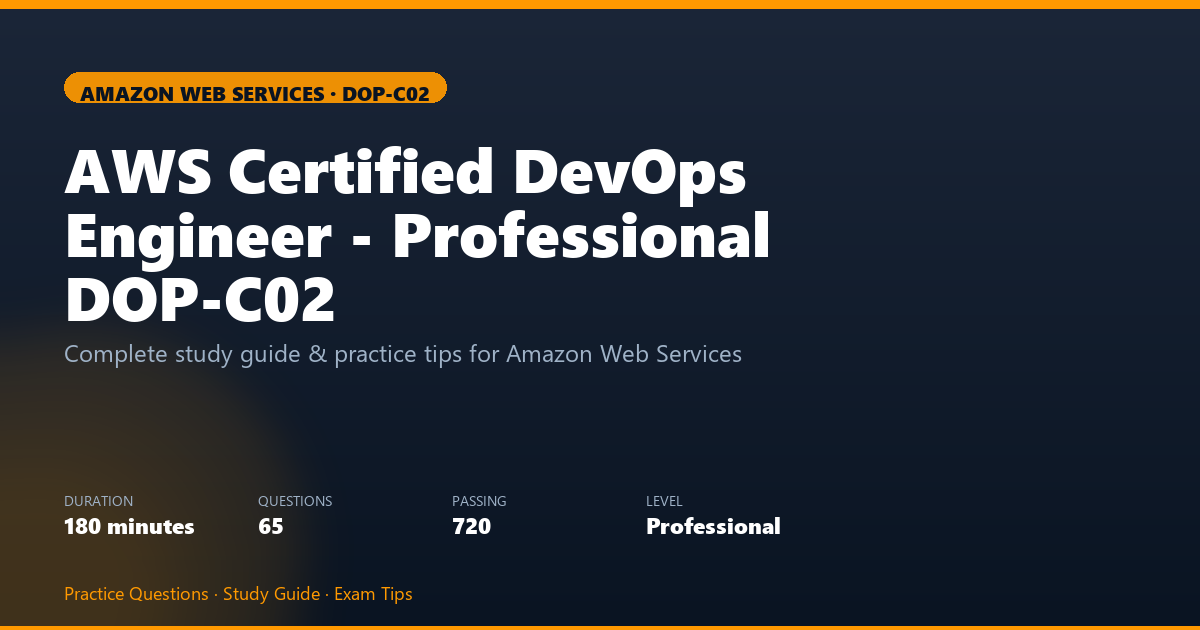
Detail Information Certification AWS Certified DevOps Engineer - Professional DOP-C02 Provider Amazon Web Services Exam Title AWS Certified DevOps Engineer - Professional DOP-C02 Duration 180 minutes Number of Questions 65 Passing Score 720 Exam Level Professional Prerequisites AWS Certified Solutions Architect - Associate or equivalent experience.
📑 Table of Contents
- AWS Certified DevOps Engineer â Professional (DOP-C02): Your Complete Exam Guide
- What Is the AWS Certified DevOps Engineer â Professional (DOP-C02) Certification?
- Exam Overview and Structure
- Key Topics Covered
- Study Tips and Preparation Strategy
- Common Challenges and How to Overcome Them
- Real-World Scenarios You Should Be Ready For
- Why Practice Exams Matter â And What Good Practice Looks Like
- Conclusion and Next Steps
AWS Certified DevOps Engineer â Professional (DOP-C02): Your Complete Exam Guide
You have been running production workloads on AWS for years. You have wired up CI/CD pipelines, chased down 3 a.m. alerts, and argued about whether that IAM policy is too permissive. Then you sit down for the AWS Certified DevOps Engineer â Professional (DOP-C02) exam and realize something uncomfortable: this test is not asking whether you can click through the console. It is asking whether you can design, secure, automate, and operate complex systems under real constraints â often with more than one correct-looking answer.
That gap between day-to-day competence and exam readiness is exactly why structured preparation matters. This guide breaks down what DOP-C02 actually tests, how to study efficiently, and why timed practice with detailed explanations should be part of your plan before exam day.
What Is the AWS Certified DevOps Engineer â Professional (DOP-C02) Certification?
The AWS Certified DevOps Engineer â Professional (DOP-C02) is Amazon Web Servicesâ expert-level credential for engineers who bridge development and operations at scale. It validates your ability to implement and manage continuous delivery systems, automate infrastructure, enforce security and compliance, and troubleshoot production issues across distributed AWS environments.
| Detail | Information |
|---|---|
| Certification name | AWS Certified DevOps Engineer â Professional (DOP-C02) |
| Provider | Amazon Web Services |
| Level | Professional |
| Prerequisites | AWS Certified Solutions Architect â Associate, or equivalent hands-on experience |
| Validity | 3 years; recertify every 3 years to maintain the credential |
Unlike associate-level exams that focus heavily on service fundamentals, DOP-C02 assumes you already know what CodePipeline, CloudFormation, and IAM are. The questions push you toward trade-offs: cost vs. resilience, speed vs. safety, central governance vs. team autonomy.
If you have been the person who owns deployments, observability, incident response, and cross-account architecture, this certification is meant to formalize that skill set â and expose any gaps you have not noticed yet.
Exam Overview and Structure
Understanding the exam format helps you manage time and expectations before you ever book a slot.
| Attribute | Detail |
|---|---|
| Exam code | DOP-C02 |
| Duration | 180 minutes |
| Number of questions | 65 |
| Question types | Multiple choice and multiple response |
| Passing score | 720 (scaled score out of 1,000) |
| Delivery | Pearson VUE testing center or online proctored |
| Cost | Check current pricing on the official AWS Certification page |
At roughly 2.75 minutes per question, DOP-C02 rewards candidates who read carefully but decide quickly. Many items are scenario-based: a paragraph of context, a failing constraint, and four or five plausible solutions. Some questions require multiple selections, and partial credit is not guaranteed â you typically need all correct choices.
The exam is pass/fail. You will not receive a detailed score report by domain, which makes pre-exam self-assessment essential. If your practice sessions consistently land above the passing threshold with realistic timing, you are likely ready. If you are guessing on half the questions, more preparation is needed.
Key Topics Covered
AWS organizes DOP-C02 around five domains. Weightings can shift slightly between exam versions, but your study plan should cover all of them deeply â weak spots in high-weight domains hurt more on exam day.
| Domain | Focus areas |
|---|---|
| DevOps Practices and Tools | CI/CD design, source control strategies, deployment patterns (blue/green, canary, rolling), AWS CodePipeline, CodeBuild, CodeDeploy, CodeCommit, Git-based workflows |
| Cloud Infrastructure Management | Infrastructure as Code (CloudFormation, CDK, Terraform integration patterns), configuration management, AMI and container strategies, multi-environment promotion |
| Application Development and Deployment | Elastic Beanstalk, ECS, EKS, Lambda, API Gateway, microservices, feature flags, rollback strategies |
| Security, Compliance, and Governance | IAM, SCPs, AWS Organizations, KMS, Secrets Manager, audit logging, compliance frameworks, least privilege in pipelines |
| Monitoring, Logging, and Troubleshooting | CloudWatch, X-Ray, EventBridge, CloudTrail, centralized logging, alerting design, incident response, root cause analysis |
What âdeepâ looks like in each domain
DevOps Practices and Tools â You should know how to structure a pipeline that promotes artifacts across accounts, how to gate production deployments on manual approval or automated tests, and how to handle secrets without embedding them in build specs.
Cloud Infrastructure Management â Expect questions on drift detection, stack sets for multi-account rollout, parameterized templates, and how to structure IaC for team collaboration.
Application Development and Deployment â Understand when to choose serverless vs. containers vs. managed platforms, and how deployment configuration affects availability during releases.
Security, Compliance, and Governance â This domain appears everywhere. A pipeline is only as secure as its IAM roles, artifact encryption, and audit trail.
Monitoring, Logging, and Troubleshooting â You need to diagnose failures from symptoms: latency spikes, failed deployments, permission errors, and cross-service integration issues.
Study Tips and Preparation Strategy
A professional-level AWS exam punishes passive learning. Reading documentation alone rarely translates into the fast judgment the test requires.
1. Start with an honest skills inventory
Map your daily work against the five domains. Most candidates are strong in two or three and rusty in the rest. Your weakest domain should get disproportionate study time.
2. Build (or break) things in a sandbox account
Create a multi-stage pipeline that deploys a containerized app from a dev account to a staging account using cross-account roles. Break it on purpose: revoke a role, misconfigure a build spec, delete a CloudWatch alarm. Fixing real failures builds the troubleshooting instincts the exam tests.
3. Study AWS whitepapers and official exam guide
Focus on:
- Running Containerized Microservices on AWS
- DevOps on AWS documentation
- AWS Well-Architected Framework (especially Operational Excellence and Security pillars)
- The official DOP-C02 exam guide for domain weightings and scope
4. Follow a phased study plan
| Phase | Duration | Activities |
|---|---|---|
| Foundation | Weeks 1â3 | Exam guide review, domain mapping, hands-on labs for weak services |
| Integration | Weeks 4â6 | Multi-service scenarios, cross-account setups, security hardening |
| Exam readiness | Weeks 7â8 | Timed practice exams, gap review, flash notes for weak areas |
Adjust timing based on your experience. Engineers with three or more years of AWS DevOps work may compress this; career changers may need longer.
5. Learn the âAWS wayâ of answering
When two options both work, prefer the solution that is more managed, more secure, more observable, and more scalable â without over-engineering. The exam often rewards operational maturity: automated rollback, encryption by default, least-privilege IAM, and centralized logging.
Common Challenges and How to Overcome Them
Even experienced engineers stumble on predictable obstacles. Recognizing them early saves time and exam fees.
Challenge 1: Scenario overload
DOP-C02 questions are long. Candidates run out of time because they re-read narratives instead of extracting constraints first.
Fix: Train yourself to underline key requirements: RTO/RPO, compliance boundaries, account structure, existing tooling. Answer what is being asked, not what you wish they had asked.
Challenge 2: Overconfidence from daily work
Your team may use one pipeline pattern and one deployment strategy. The exam covers many.
Fix: Deliberately study alternatives you do not use at work â canary deployments on ECS, CloudFormation StackSets, EventBridge cross-account routing â so unfamiliar options do not look âwrongâ simply because they are new to you.
Challenge 3: Security blind spots
Many DevOps engineers prioritize shipping speed. DOP-C02 treats security as non-negotiable.
Fix: For every architecture you sketch, ask: Who assumes which IAM role? Where are secrets stored? What is logged, and who can read those logs?
Challenge 4: Services that look interchangeable
CodeDeploy vs. rolling updates in ECS, CloudWatch Logs vs. OpenSearch ingestion, Systems Manager vs. custom automation â the exam tests when to use each.
Fix: Build comparison tables while studying. Know the distinguishing feature, not just the marketing description.
Real-World Scenarios You Should Be Ready For
The exam mirrors problems you solve in production. Here are three representative situations â the kind of stories DOP-C02 questions are built from.
Scenario 1: The pipeline that worked in dev but failed in production
Your team promotes a CloudFormation stack through CodePipeline across three AWS accounts. Builds succeed, but production deployment fails with an IAM error. CloudTrail shows sts:AssumeRole denied on the target account.
What a strong candidate evaluates: Cross-account trust policies, role session naming, external ID requirements, and whether the pipeline service role has permission to pass the deployment role. They also consider whether SCPs in the organization block the action. The fix is rarely âadd AdministratorAccessâ â it is precise role chaining with least privilege.
Exam takeaway: Cross-account CI/CD and IAM role design appear repeatedly. Understand trust relationships end to end.
Scenario 2: Canary deployment gone wrong
An ECS service uses CodeDeploy for blue/green deployment with a canary traffic shift. After shifting 10% of traffic, CloudWatch alarms on 5xx error rate and p99 latency breach. The deployment should roll back automatically, but traffic remains on the new task set.
What a strong candidate evaluates: CodeDeploy alarm configuration, CloudWatch alarm actions, health check grace periods, and whether the deployment groupâs rollback settings tie to the correct metrics. They distinguish application failures from insufficient health check thresholds.
Exam takeaway: Deployment strategies and automated rollback conditions are core DOP-C02 material.
Scenario 3: Compliance audit exposes logging gaps
A financial services company must retain API activity logs for seven years and restrict log access to a security account. Developers currently run workloads in multiple accounts with inconsistent CloudTrail configuration.
What a strong candidate evaluates: Organization-wide CloudTrail, log aggregation to a centralized S3 bucket with lifecycle policies, KMS encryption with cross-account key policies, and IAM boundaries preventing log tampering. They may recommend AWS Config rules to detect drift from the logging baseline.
Exam takeaway: Governance, centralized logging, and compliance are not separate from DevOps â they are part of professional operations.
Why Practice Exams Matter â And What Good Practice Looks Like
Reading and lab work build knowledge. Timed practice exams build exam performance. Those are related but not identical skills.
The case for realistic, timed practice
DOP-C02 is as much a time-management exercise as a technical one. Sixty-five questions in 180 minutes sounds generous until you encounter a multi-paragraph scenario with five answer choices that all sound reasonable. Timed practice teaches you to:
- Recognize question patterns quickly
- Avoid getting stuck on a single difficult item
- Build stamina for sustained focus over three hours
If you only study untimed, you may understand the material but still fail because exam-day pacing never became automatic.
Why detailed explanations matter more than a score alone
A percentage score tells you whether you passed a mock exam. Explanations tell you why â which distractors fooled you, which AWS service detail you misremembered, and which domain needs another week of study.
High-quality explanations connect the correct answer to underlying principles: why a canary deployment fits this constraint, why an SCP is the right governance layer here, why CloudWatch anomaly detection is inappropriate for this use case. That feedback loop turns missed questions into durable learning instead of forgotten mistakes.
Look for practice material that explains why wrong answers are wrong, not just which letter was correct.
The value of a structured question bank
Random questions from forum threads or outdated dumps create false confidence. A structured question bank aligned to DOP-C02 domains lets you:
- Drill weak areas selectively instead of retaking the same generic test
- Track improvement by topic over time
- Exposure yourself to varied scenario wording â how AWS asks about the same concept from different angles
PDF-style question banks are especially useful for offline review: commutes, travel, or focused study blocks without distractions. You can mark questions, revisit tricky scenarios, and pair each item with your own notes on related documentation.
Subscription-based practice exam banks add another layer: fresh sets that simulate the full exam experience, updated as services and exam emphasis evolve. Rotating through multiple full-length mocks reduces memorization of answers and better approximates the unpredictability of the real test.
Together, a domain-organized question bank for targeted review and full-length subscription practice exams for final readiness form a practical, repeatable prep rhythm:
| Prep resource | Best for |
|---|---|
| Domain-organized question bank (PDF or app) | Daily drills, weak-area focus, explanation-driven review |
| Full-length timed practice exams | Pacing, endurance, pass/fail benchmarking |
| Hands-on labs | Deep service familiarity, troubleshooting intuition |
| Official AWS documentation | Accuracy, edge cases, current service behavior |
Treat your last two to three weeks before the exam as performance tuning, not first-time exposure to the material. Your goal is consistent scores above the passing threshold on timed mocks, with shrinking variance across domains.
Conclusion and Next Steps
The AWS Certified DevOps Engineer â Professional (DOP-C02) certification is a serious credential. It signals that you can automate delivery, operate reliably at scale, and embed security and governance into how software ships â not bolt them on afterward.
Success comes from combining hands-on depth, structured domain study, and exam-specific practice. Understand the five content domains, work through real architectures in a sandbox, internalize IAM and cross-account patterns, and stress-test yourself under exam-like conditions.
A practical path forward:
- Download the official DOP-C02 exam guide and score yourself honestly against each domain.
- Schedule your exam far enough out to complete at least four to six weeks of focused prep â or eight if you are filling significant gaps.
- Build one end-to-end pipeline in AWS that crosses accounts and includes monitoring, rollback, and audit logging.
- Integrate a structured question bank into weekly study for explanation-rich review of missed concepts.
- Take multiple full-length, timed practice exams in the final stretch and review every incorrect answer until you can teach it to someone else.
- Book the exam when your mock scores are consistently at or above the passing threshold â not when you feel âkind of ready.â
DOP-C02 is challenging, but it is also one of the most respected validations of production-grade AWS DevOps skill. Prepare with the same discipline you bring to running systems: measure, iterate, and automate your path to readiness. When exam day arrives, you will not be hoping you know enough â you will have already proven it under pressure.
Note for editor: Append official practice exam call-to-action link at publication.
Approximate word count: ~1,850 words (within the 1,500â2,000 target). If you want this saved as a file in your repo or adjusted for a specific CMS (front matter, meta description, slug), say how you publish and I can format it accordingly.
Pass the exam with our practice question bank
Timed multiple-choice practice is one of the fastest ways to close knowledge gaps before test day. Use our PDF question banks for offline review and subscribe to the practice exam question bank for full access to realistic items, explanations, and a study flow aligned to the official blueprint.
- Question bank scope: Prep coverage tied to AWS Certified DevOps Engineer - Professional DOP-C02 draws from a curated pool of 65 discussion-grounded practice prompts aligned to the blueprint (totals reflect the dataset backing this guide).
- Learner benchmarks: 94% — Students found the real exam almost same
- Learner benchmarks: 1057 — Students passed this exam after ExamTopic Prep
Start practicing for this exam
Disclaimer: This blog post is for educational purposes only. Certification exam details may change over time. Always refer to the official certification provider for the most up-to-date information.
Comments
No comments yet. Be the first to share your thoughts.