![AWS Certified Machine Learning - Specialty (MLS-C01) Exam Guide: Complete Preparation for AWS Certified Machine Learning - Specialty (MLS-C01) [2026]](/_next/image?url=https%3A%2F%2Fstorage.googleapis.com%2Fdevcopublich%2Fblog-covers%2Famazon%2FAWS%20Certified%20Machine%20Learning%20-%20Specialty%2Faws-certified-machine-learning-specialty-mls-c01_cover.png&w=3840&q=75)
📋 Exam Quick Facts
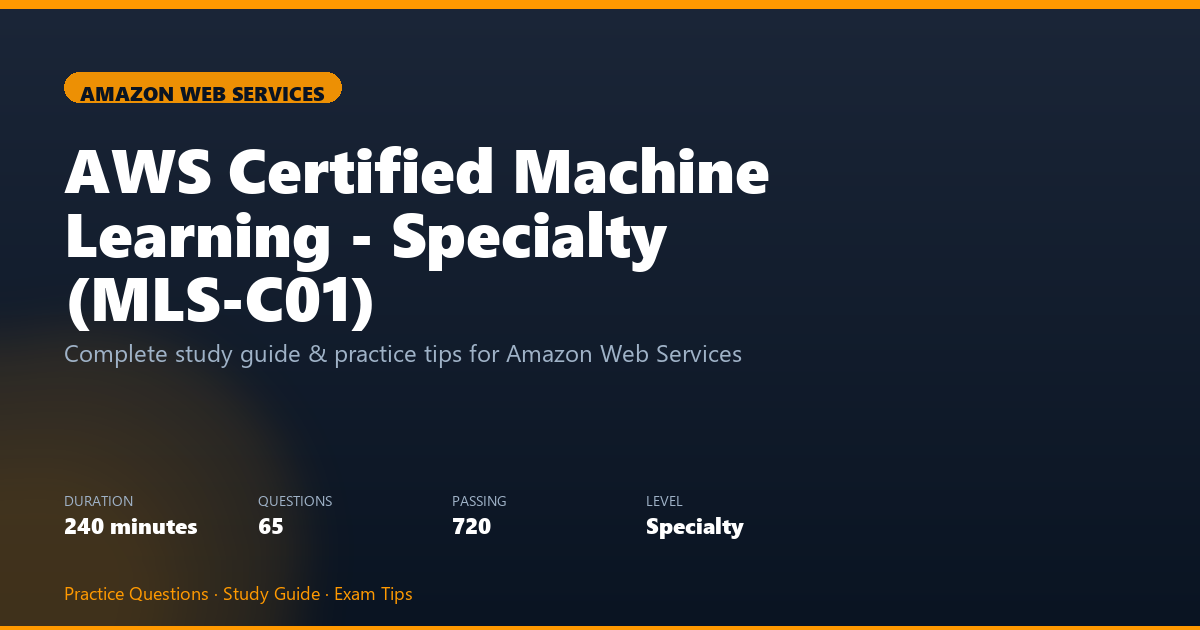
Detail Information Certification AWS Certified Machine Learning - Specialty (MLS-C01) Provider Amazon Web Services Exam Title AWS Certified Machine Learning - Specialty (MLS-C01) Duration 240 minutes Number of Questions 65 Passing Score 720 Exam Level Specialty Prerequisites Proficiency in Python or R, familiarity with machine learning concepts.
📑 Table of Contents
- AWS Certified Machine Learning - Specialty (MLS-C01): Your Complete Exam Guide
- What Is the AWS Certified Machine Learning - Specialty (MLS-C01) Certification?
- Exam Overview and Structure
- Key Topics Covered
- Study Tips and Preparation Strategy
- Common Challenges and How to Overcome Them
- Real-World Scenarios Youâll Recognize on Exam Day
- Why Practice Exams Matter â and How to Use Them Effectively
- Conclusion and Next Steps
AWS Certified Machine Learning - Specialty (MLS-C01): Your Complete Exam Guide
Youâve trained models, tuned hyperparameters, and shipped predictions into production â but when your VP asks whether you can prove your ML expertise on AWS, a strong resume only gets you halfway there. The AWS Certified Machine Learning - Specialty (MLS-C01) certification is how practitioners turn hands-on experience into a credential that hiring managers, clients, and engineering leaders recognize instantly.
This guide walks you through what the exam actually tests, how to prepare efficiently, and how to avoid the mistakes that trip up even experienced data scientists.
What Is the AWS Certified Machine Learning - Specialty (MLS-C01) Certification?
The AWS Certified Machine Learning - Specialty (MLS-C01) is Amazon Web Servicesâ advanced credential for professionals who design, build, deploy, and maintain machine learning solutions on AWS. Unlike the broad Solutions Architect or Developer Associate exams, MLS-C01 goes deep on the full ML lifecycle â from raw data ingestion through model monitoring in production.
| Attribute | Details |
|---|---|
| Certification name | AWS Certified Machine Learning - Specialty (MLS-C01) |
| Provider | Amazon Web Services |
| Level | Specialty |
| Prerequisites | Proficiency in Python or R; familiarity with ML concepts |
| Validity | 3 years (re-certify every three years to maintain status) |
| Passing score | 720 (scaled score out of 1,000) |
This is not an entry-level certification. AWS expects you to understand statistical modeling, feature engineering, SageMaker workflows, and the operational realities of running ML at scale. If youâve built recommendation systems, fraud detectors, or forecasting pipelines â even on other clouds â you already have relevant context. The exam simply asks you to express that knowledge through AWS-native services and best practices.
Who should pursue it?
- Data scientists and ML engineers moving production workloads to AWS
- Solutions architects designing intelligent applications
- DevOps/MLOps engineers responsible for model deployment and monitoring
- Technical leaders who need credible ML credentials for enterprise engagements
Exam Overview and Structure
Understanding the exam format before you study saves hours of misplaced effort.
| Exam component | Specification |
|---|---|
| Duration | 240 minutes (4 hours) |
| Number of questions | 65 |
| Question types | Multiple choice and multiple response |
| Passing score | 720 |
| Delivery | Pearson VUE testing center or online proctored |
| Cost | $300 USD (check AWS for current pricing) |
At roughly 3.7 minutes per question, time management matters. Many questions present a paragraph-long scenario â a healthcare startup migrating models, a retailer optimizing inference costs â and ask you to choose the best AWS service, architecture pattern, or troubleshooting step. Youâre rarely tested on isolated trivia; youâre tested on judgment.
The exam blueprint organizes content into four domains:
| Domain | Approximate weight |
|---|---|
| Data Engineering | ~20% |
| Exploratory Data Analysis | ~24% |
| Modeling | ~36% |
| Machine Learning Implementation and Operations | ~20% |
Notice that Modeling carries the heaviest weight, but donât underestimate the operational domains. Candidates with strong theoretical ML backgrounds often lose points on SageMaker deployment patterns, endpoint scaling, and monitoring â precisely because those topics feel âobviousâ until youâre staring at four plausible answers.
Key Topics Covered
MLS-C01 rewards breadth and depth across the ML pipeline. Here are the areas you should master.
1. Data Management and Preparation
Before any model trains, data must be collected, cleaned, transformed, and stored appropriately.
Core services and concepts:
- Amazon S3 â primary data lake storage; versioning, lifecycle policies, encryption
- AWS Glue â ETL, crawlers, data catalog, job bookmarks
- Amazon Kinesis â real-time streaming ingestion (Data Streams, Firehose)
- Amazon EMR â large-scale batch processing with Spark
- AWS Lake Formation â governance, permissions, data access control
- Feature stores â SageMaker Feature Store for online/offline feature serving
What the exam tests: Choosing the right ingestion path (batch vs. streaming), handling imbalanced datasets, dealing with missing values, encoding categorical variables, and applying appropriate transformations at scale.
2. Machine Learning Model Development
This is the heart of the certification â selecting algorithms, tuning models, and using SageMaker effectively.
Core services and concepts:
- Amazon SageMaker â training jobs, built-in algorithms, custom containers, hyperparameter tuning
- Algorithm selection â linear models, tree-based methods, neural networks, clustering, dimensionality reduction
- Built-in algorithms â XGBoost, Linear Learner, BlazingText, DeepAR, Factorization Machines, and others
- Hyperparameter optimization â Bayesian vs. random search, early stopping
- AutoML â SageMaker Autopilot for automated model selection
- Frameworks â TensorFlow, PyTorch, scikit-learn integration within SageMaker
What the exam tests: Matching business problems to algorithms (classification, regression, clustering, recommendation, time-series forecasting), understanding bias-variance tradeoffs, and knowing when to use built-in algorithms versus custom training scripts.
3. Model Evaluation, Monitoring, and Deployment
A model that never reaches production â or fails silently after launch â has no business value.
Core services and concepts:
- SageMaker endpoints â real-time, serverless, asynchronous, batch transform
- Multi-model and multi-container endpoints â cost optimization for many models
- Amazon Elastic Inference â GPU acceleration at lower cost
- Model monitoring â data drift, concept drift, SageMaker Model Monitor
- A/B testing and shadow deployments â SageMaker production variants
- AWS CloudWatch â metrics, alarms, logging
- CI/CD for ML â SageMaker Pipelines, CodePipeline integration
What the exam tests: Deployment architecture decisions, inference cost optimization, detecting model degradation, and operational troubleshooting.
4. Ethical and Legal Considerations in Machine Learning
AWS increasingly emphasizes responsible AI â and so does the exam.
Core concepts:
- Bias detection and mitigation â Clarify, SageMaker Model Monitor fairness metrics
- Explainability â SHAP, feature importance, SageMaker Clarify
- Data privacy â encryption at rest and in transit, IAM policies, VPC configurations
- Compliance â GDPR considerations, data residency, audit trails via CloudTrail
- Human review workflows â SageMaker Ground Truth, augmented AI
What the exam tests: Recognizing when a model may discriminate against protected groups, choosing appropriate explainability techniques, and implementing governance controls.
Study Tips and Preparation Strategy
Passing MLS-C01 requires a structured plan. Hereâs a proven approach used by successful candidates.
Phase 1: Foundation (Weeks 1â2)
- Download the official exam guide from AWS and treat it as your syllabus.
- Review AWS ML whitepapers â especially the Well-Architected Machine Learning Lens and SageMaker documentation.
- Assess your gaps honestly. Strong in deep learning but weak on data engineering? Allocate time accordingly.
Phase 2: Hands-On Practice (Weeks 3â6)
Theory alone wonât pass this exam. You need muscle memory with AWS consoles and APIs.
- Complete the SageMaker workshop labs (built-in algorithms, training, deployment, monitoring)
- Build a small end-to-end project: ingest data â train â deploy â monitor
- Practice with AWS Glue and Feature Store â these appear frequently
- Work through at least one time-series forecasting and one NLP scenario using SageMaker built-ins
Phase 3: Exam-Specific Review (Weeks 7â8)
- Focus on service selection scenarios â the exam loves âCompany X needs Y; which service?â
- Memorize algorithm characteristics (when to use XGBoost vs. Linear Learner vs. BlazingText)
- Review IAM permissions required for common SageMaker operations
- Study cost optimization patterns for inference and training
Practical Study Tips
| Tip | Why it matters |
|---|---|
| Learn SageMaker terminology | Endpoint variants, training job names, and pipeline stages appear constantly |
| Understand data formats | RecordIO, Protobuf, CSV, Parquet â format choices affect performance |
| Know your instance types | ml.m5, ml.p3, ml.inf1 â matching workload to hardware saves money |
| Practice eliminating wrong answers | Two answers are often clearly wrong; narrow to two, then apply judgment |
| Read AWS blog posts on ML | Real-world architecture patterns mirror exam scenarios |
Common Challenges and How to Overcome Them
Even seasoned ML practitioners stumble on MLS-C01. Here are the hurdles youâre most likely to face â and how to clear them.
Challenge 1: Breadth Over Depth
MLS-C01 spans data engineering, statistics, deep learning, and DevOps. Specialists who live in one lane often find unfamiliar territory.
Solution: Use the exam guide domains as a checklist. Spend at least one full study session on each domain, even your strongest area. The operational questions can surprise pure data scientists.
Challenge 2: AWS Service Overlap
When should you use Glue vs. EMR? Kinesis Data Streams vs. Firehose? SageMaker Batch Transform vs. asynchronous endpoints?
Solution: Create comparison tables for commonly confused services. Focus on the deciding factor â latency requirements, data volume, team skill set, cost constraints.
Challenge 3: Scenario-Based Question Fatigue
After 40 questions of dense scenarios, reading comprehension degrades. Candidates misread âleast operational overheadâ as âlowest costâ and pick the wrong answer.
Solution: During practice exams, highlight what the question actually asks. Train yourself to identify keywords: âmost cost-effective,â âleast latency,â âminimal custom code,â âregulatory compliance.â
Challenge 4: Underestimating Responsible AI
Ethical and legal questions may feel like soft topics compared to algorithm tuning â but theyâre scored the same.
Solution: Study SageMaker Clarify capabilities, understand fairness metrics (e.g., disparate impact), and know when human-in-the-loop review is required.
Real-World Scenarios Youâll Recognize on Exam Day
The MLS-C01 exam mirrors problems practitioners face daily. Here are three representative scenarios â the kind of situations that translate directly into test questions.
Scenario 1: The Fraud Detection Pipeline
A fintech company processes millions of credit card transactions daily. Their data science team has a trained XGBoost model that flags suspicious activity. Currently, batch scoring runs overnight, but fraud must be caught in near real-time.
Exam-relevant decisions:
- Ingest streaming data via Amazon Kinesis Data Streams
- Transform and enrich features using AWS Lambda or Kinesis Data Analytics
- Deploy the model to a SageMaker real-time endpoint with auto-scaling
- Monitor for data drift as transaction patterns shift seasonally
- Apply SageMaker Clarify to ensure the model doesnât discriminate by geography or demographic proxies
This scenario tests domain knowledge across streaming ingestion, low-latency inference, and responsible AI â all in one business context.
Scenario 2: The Healthcare Imaging Model
A medical imaging startup trains a convolutional neural network on thousands of X-ray images stored in S3. They must comply with HIPAA, explain predictions to clinicians, and retrain periodically as new labeled data arrives.
Exam-relevant decisions:
- Store data in encrypted S3 buckets with strict IAM and VPC controls
- Use SageMaker Ground Truth for expert labeling workflows
- Train with a custom TensorFlow container on GPU instances (
ml.p3orml.g4dn) - Deploy with SageMaker Model Monitor to detect accuracy degradation
- Generate SHAP-based explanations via SageMaker Clarify for clinician trust
Here the exam weighs security, explainability, and MLOps equally â reflecting how regulated industries actually operate.
Scenario 3: The Retail Demand Forecasting Challenge
A global retailer wants to forecast product demand across 10,000 SKUs using five years of sales history, promotional calendars, and weather data. Accuracy directly affects inventory costs.
Exam-relevant decisions:
- Prepare time-series data in RecordIO-Protobuf format for SageMaker DeepAR
- Use SageMaker hyperparameter tuning with early stopping across multiple SKUs
- Evaluate with quantile loss rather than simple RMSE when stockout costs differ from overstock costs
- Deploy forecasts via batch transform for nightly inventory updates
- Store engineered features in SageMaker Feature Store for consistency between training and inference
Time-series forecasting appears regularly on MLS-C01. Understanding DeepAR, data formatting, and batch vs. real-time deployment separates prepared candidates from unprepared ones.
Why Practice Exams Matter â and How to Use Them Effectively
Reading documentation and running labs builds knowledge. Timed practice exams build exam-day performance. There is a meaningful gap between knowing SageMaker exists and selecting the correct service under pressure with 3.7 minutes per question.
Hereâs why structured practice should be a non-negotiable part of your preparation.
Timed Practice Builds Real Exam Stamina
Four hours is a long sit. Your concentration peaks around question 15 and often dips near questions 40â50. Timed practice sessions train you to maintain accuracy when mental fatigue sets in. Aim to complete full 65-question sessions at least three times before exam day, strictly observing the 240-minute limit.
Detailed Explanations Turn Wrong Answers into Learning
Getting a question wrong hurts briefly; understanding why you got it wrong sticks permanently. High-quality practice materials provide explanations that go beyond âthe correct answer is B.â They walk through the elimination logic, reference the relevant AWS service documentation, and explain why tempting alternatives fail.
When you miss a question about asynchronous inference vs. batch transform, a strong explanation clarifies latency tolerance, payload size limits, and cost structure â concepts youâll apply across dozens of other scenarios.
A Structured Question Bank Covers the Full Blueprint
Random blog quizzes and scattered flashcards leave gaps. A comprehensive question bank organized by exam domain ensures youâve encountered every topic at least once â including the easy-to-skip areas like Lake Formation permissions or Factorization Machines use cases.
Look for question banks that mirror the official domain weightings:
| Domain | Target practice coverage |
|---|---|
| Data Engineering | ~13 questions per full mock exam |
| Exploratory Data Analysis | ~16 questions |
| Modeling | ~23 questions |
| ML Implementation and Operations | ~13 questions |
PDF-Style Question Banks vs. Subscription Practice Platforms
Both formats serve different â and complementary â purposes in a well-rounded study plan.
PDF-style question banks excel when you want:
- Offline access during commutes or travel without relying on connectivity
- Printable review sheets for last-minute revision the morning of your exam
- Topic-focused drills â print only the Data Engineering section, for example
- A permanent reference you can annotate, highlight, and revisit months later during re-certification
Subscription-based practice exam platforms excel when you want:
- Simulated exam environments with timers, scoring, and progress tracking
- Regularly updated questions reflecting AWS service changes and new exam patterns
- Performance analytics showing weak domains so you can study surgically
- Unlimited retakes to measure improvement week over week
The most successful candidates combine both: use PDF question banks for targeted domain review and deep-dive sessions, then use subscription practice exams for full-length timed simulations and progress measurement. Treat practice exams as diagnostic tools first and confidence builders second. A score of 65% on your first attempt isnât failure â itâs a map showing exactly where to focus your final two weeks.
Recommended practice rhythm:
- Week 4: First untimed domain quiz to establish baseline
- Week 6: First full timed mock exam â donât expect to pass
- Week 7: Review every missed question; drill weak domains with PDF-style topic sets
- Week 8: Second full timed mock exam â target 75%+ consistently
- Final 3 days: Light review only; one more full simulation if time permits
When you consistently score above 75% on timed practice exams â comfortably above the 720 passing threshold â youâre ready.
Conclusion and Next Steps
The AWS Certified Machine Learning - Specialty (MLS-C01) certification validates that you can architect, build, and operate ML solutions on the worldâs most widely adopted cloud platform. Itâs challenging precisely because it reflects real practitioner work: messy data, competing service options, cost pressures, and the ethical obligations that come with automated decision-making.
Your path to success is straightforward:
- Map your gaps against the official exam guide
- Build hands-on SageMaker experience â nothing replaces doing the work
- Study service selection patterns until they become instinct
- Invest in quality practice exams â timed simulations with detailed explanations and structured question banks accelerate preparation more than passive reading ever will
- Schedule the exam while momentum is high, ideally within two months of starting structured prep
Whether youâre advancing within your organization, pursuing a new role, or delivering ML solutions to enterprise clients, MLS-C01 signals that you donât just understand machine learning theory â you can implement it responsibly and at scale on AWS.
Start with the official exam guide, spin up your first SageMaker training job this week, and add structured practice exams to your calendar. The credential is within reach for any practitioner willing to prepare with the same rigor they bring to production ML systems.
Editorâs note: An official practice exam resource link will be appended to this article for readers ready to begin timed preparation.
Pass the exam with our practice question bank
Timed multiple-choice practice is one of the fastest ways to close knowledge gaps before test day. Use our PDF question banks for offline review and subscribe to the practice exam question bank for full access to realistic items, explanations, and a study flow aligned to the official blueprint.
- Question bank scope: Prep coverage tied to AWS Certified Machine Learning - Specialty (MLS-C01) draws from a curated pool of 65 discussion-grounded practice prompts aligned to the blueprint (totals reflect the dataset backing this guide).
- Learner benchmarks: 94% — Students found the real exam almost same
- Learner benchmarks: 1057 — Students passed this exam after ExamTopic Prep
Start practicing for this exam
Disclaimer: This blog post is for educational purposes only. Certification exam details may change over time. Always refer to the official certification provider for the most up-to-date information.
Comments
No comments yet. Be the first to share your thoughts.