![AWS Certified Developer - Associate DVA-C02 Exam Guide: Complete Preparation for AWS Certified Developer - Associate DVA-C02 [2026]](/_next/image?url=https%3A%2F%2Fstorage.googleapis.com%2Fdevcopublich%2Fblog-covers%2Famazon%2FAWS%20Certified%20Developer%20-%20Associate%20DVA-C02%2Faws-certified-developer-associate-dva-c02_cover.png&w=3840&q=75)
📋 Exam Quick Facts
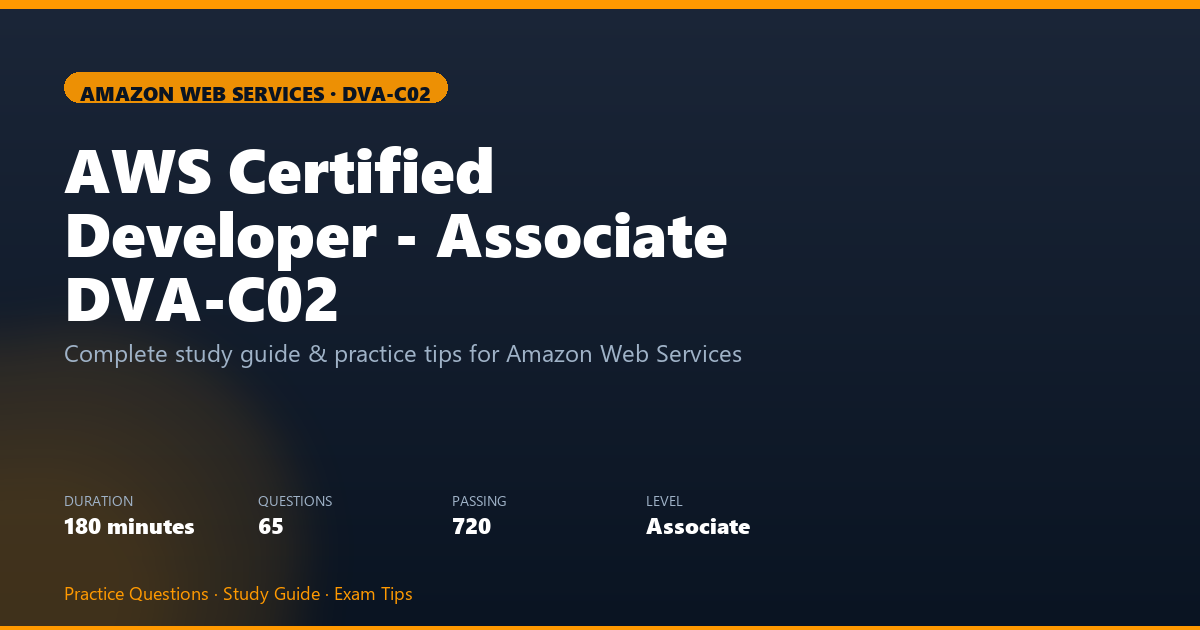
Detail Information Certification AWS Certified Developer - Associate DVA-C02 Provider Amazon Web Services Exam Title AWS Certified Developer - Associate DVA-C02 Duration 180 minutes Number of Questions 65 Passing Score 720 Exam Level Associate Prerequisites At least one year of professional software development experience with cloud-based applications.
📑 Table of Contents
- AWS Certified Developer â Associate (DVA-C02): Your Complete Exam Guide
- What Is the AWS Certified Developer â Associate (DVA-C02) Certification?
- Exam Overview and Structure
- Key Topics Covered
- Study Tips and Preparation Strategy
- Real-World Scenarios: What the Exam Expects You to Know
- Common Challenges and How to Overcome Them
- Why Practice Exams Matter: Timed Drills, Explanations, and Structured Question Banks
- Conclusion and Next Steps
AWS Certified Developer â Associate (DVA-C02): Your Complete Exam Guide
You deploy a Lambda function on Friday afternoon. It works perfectly in your test account. On Monday, production traffic spikes, your API Gateway throttles requests, and a downstream DynamoDB table starts throwing ProvisionedThroughputExceededException errors. Your on-call pager does not care that you passed a trivia quiz about AWS service namesâit cares whether you can design, secure, deploy, and troubleshoot real applications on AWS.
That gap between âknowing AWS existsâ and âbuilding reliably on AWSâ is exactly what the AWS Certified Developer â Associate (DVA-C02) certification measures. If you have been writing code for cloud-based applications and want a credential that validates hands-on developer skillsânot just architecture diagramsâthis exam deserves a place on your roadmap.
What Is the AWS Certified Developer â Associate (DVA-C02) Certification?
The AWS Certified Developer â Associate is an associate-level credential from Amazon Web Services (AWS) aimed at software developers who build and maintain applications on the AWS platform. The current exam code is DVA-C02, which reflects modern development practices: serverless-first thinking, CI/CD pipelines, security embedded in application design, and operational excellence using AWS-native tools.
Unlike the Solutions Architect â Associate exam, which leans heavily toward designing systems at a high level, the Developer â Associate exam expects you to think like someone who writes, deploys, debugs, and optimizes application code. You should understand how SDKs, IAM policies, deployment services, and managed databases fit together in a production workflow.
| Detail | Information |
|---|---|
| Certification name | AWS Certified Developer â Associate (DVA-C02) |
| Provider | Amazon Web Services (AWS) |
| Level | Associate |
| Prerequisites (recommended) | At least one year of professional software development experience with cloud-based applications |
| Exam duration | 180 minutes |
| Number of questions | 65 |
| Passing score | 720 (scaled score out of 1000) |
| Validity | 3 years; renew by taking the latest version of the exam |
AWS positions this certification for developers who can:
- Build secure, scalable applications using AWS services
- Implement application security and access controls
- Deploy and debug cloud-native workloads
- Integrate AWS services through SDKs and APIs
- Apply DevOps practices using AWS tooling
If you already work with services like Lambda, API Gateway, DynamoDB, S3, ECS, and CodePipeline, you are closer to exam readiness than you might thinkâbut the exam will test whether you know the right service and configuration for a given scenario, not just whether you have used one before.
Exam Overview and Structure
The DVA-C02 exam is a 180-minute, 65-question assessment delivered at a testing center or online through proctored scheduling. Questions are a mix of multiple choice and multiple response formats. AWS does not publish the exact split between scored and unscored questions, so treat every question as if it counts.
The passing score is 720 on a scaled scoring system ranging from 100 to 1000. You do not need a perfect score. You do need consistent performance across all domains, because weak spots in security or deployment can drag down your overall result even if you excel elsewhere.
How the exam feels in practice
Most candidates report that DVA-C02 is scenario-heavy. A typical question describes a development team, an existing architecture, and a business requirementâthen asks what change best satisfies performance, security, cost, or operational goals. Many distractors are services that could work but are suboptimal, overly complex, or misaligned with AWS best practices.
Expect questions that reference:
- IAM roles vs. users vs. resource policies
- Lambda concurrency, environment variables, and VPC configuration
- CI/CD stages and deployment strategies (blue/green, rolling, canary)
- DynamoDB capacity modes, indexes, and streams
- S3 event notifications and security controls
- CloudWatch Logs, metrics, alarms, and X-Ray tracing
Time management matters. With 65 questions in 180 minutes, you have roughly 2.75 minutes per question on averageâbut some scenarios take longer to read. A practical approach is to answer confident questions first, flag lengthy ones, and leave 15â20 minutes at the end for review.
Key Topics Covered
DVA-C02 is organized around five content domains. AWS publishes weightings that shift slightly over time, but the following breakdown reflects the general emphasis candidates should expect:
| Domain | Focus areas | Typical exam angles |
|---|---|---|
| Designing Applications for Performance and Scalability | Lambda, API Gateway, caching, asynchronous processing, load patterns | Choosing the right compute model, optimizing cold starts, decoupling with SQS/SNS/EventBridge |
| Implementing Security Controls in a Multi-Tier Application Architecture | IAM, encryption, secrets management, application-level security | Least privilege, role assumption, KMS, Cognito, securing data in transit and at rest |
| Deploying and Managing Infrastructure Services | CloudFormation, Elastic Beanstalk, ECS/EKS basics, configuration | Repeatable deployments, environment promotion, infrastructure as code patterns |
| Designing Database Strategies for Performance, Availability, and Scalability | DynamoDB, RDS, ElastiCache, S3 as storage | Index design, read/write capacity, caching layers, backup and recovery |
| Implementing a DevOps Strategy Using AWS Tools | CodeCommit, CodeBuild, CodeDeploy, CodePipeline, CloudWatch, X-Ray | Pipeline design, automated testing, deployment strategies, observability |
What âdepthâ looks like for developers
You do not need to memorize every API parameter, but you should understand behavior and trade-offs. For example:
- When does DynamoDB on-demand beat provisioned capacity?
- Why attach an IAM role to Lambda instead of embedding access keys?
- How does CodeDeployâs blue/green deployment reduce downtime compared to in-place updates?
- What is the difference between SQS standard and FIFO queues for an order-processing workflow?
The exam rewards developers who understand why AWS recommends a pattern, not just what the service is called.
Study Tips and Preparation Strategy
A structured plan beats random video watching. Here is a practical preparation approach that works for most working developers.
1. Start with the official exam guide
Download the DVA-C02 exam guide from AWS and use it as your syllabus. Map each domain to your current experience. Highlight gaps honestlyâmost developers are strong in compute and weaker in IAM policy syntax or CloudFormation intrinsic functions.
2. Learn by building, not just reading
Create a small but realistic project:
- A serverless REST API (API Gateway + Lambda + DynamoDB)
- CI/CD pipeline with CodePipeline
- S3 upload flow with presigned URLs
- CloudWatch alarms and structured logging
When you build, break things on purpose. Remove an IAM permission, exceed DynamoDB throughput, and watch what error appears. Exam questions often describe symptoms; your job is to recognize root causes.
3. Use the AWS documentation strategically
The exam aligns closely with AWS best practices documented in service FAQs, developer guides, and Well-Architected Framework pillarsâespecially Operational Excellence and Security. Read documentation for services you use daily, and skim unfamiliar ones at the âhow developers integrate with thisâ level.
4. Follow a weekly study rhythm
| Week | Focus |
|---|---|
| 1â2 | Security (IAM, KMS, Cognito, secrets) + review exam guide |
| 3 | Compute and integration (Lambda, API Gateway, SQS, SNS, EventBridge) |
| 4 | Databases (DynamoDB deep dive, RDS, ElastiCache) |
| 5 | Deployment and IaC (CloudFormation, CodeDeploy, Beanstalk) |
| 6 | DevOps tooling and observability (CodePipeline, CloudWatch, X-Ray) |
| 7â8 | Practice exams, weak-area review, timed drills |
Adjust timing based on your background, but keep practice questions in the final weeksânot the first.
5. Make flashcards for decision patterns
Create cards that compare similar services:
- SQS vs. SNS vs. EventBridge
- Secrets Manager vs. SSM Parameter Store
- ECS vs. Lambda vs. Elastic Beanstalk
- DynamoDB GSI vs. LSI
- Cognito User Pools vs. Identity Pools
These comparisons appear repeatedly in exam scenarios.
Real-World Scenarios: What the Exam Expects You to Know
Theory sticks when it maps to situations you might actually face. Here are three realistic scenarios that mirror the style and substance of DVA-C02 questions.
Scenario 1: Securing a multi-tier web application
Your team runs a three-tier application: a React frontend, a Node.js API on ECS, and an RDS PostgreSQL database. The API currently uses long-lived access keys stored in environment variables. Security review flagged this as high risk.
What the exam wants you to consider: Replace embedded credentials with IAM roles for tasks, store secrets in Secrets Manager or SSM Parameter Store, enforce encryption in transit (TLS) and at rest (KMS), and restrict database access through security groups. For user authentication, Amazon Cognito may be appropriate if the question involves customer sign-up and federated identityânot just backend service permissions.
This scenario tests the security domain and your ability to choose least-privilege designs over convenient but dangerous shortcuts.
Scenario 2: Scaling an event-driven order pipeline
An e-commerce startup processes orders using API Gateway and Lambda. During flash sales, orders queue up, Lambda times out, and duplicate charges appear when clients retry failed requests.
What the exam wants you to consider: Decouple ingestion with SQS, implement idempotency keys in DynamoDB, tune Lambda reserved concurrency and timeout settings, and use DLQs for poison messages. API Gateway throttling and caching may also factor into the best answer depending on whether the bottleneck is compute, downstream dependency, or client retry behavior.
This scenario blends performance/scalability with DevOps observabilityâyou should know how CloudWatch metrics and structured logs help diagnose throttling and failures.
Scenario 3: Zero-downtime deployment for a production API
Your team needs to release a new API version weekly with minimal customer impact. Current deployments overwrite Lambda functions in place, causing brief errors during traffic shifts.
What the exam wants you to consider: CodeDeploy or Lambda aliases and weighted traffic for canary releases, automated rollback triggers based on CloudWatch alarms, and pipeline gates in CodePipeline that require tests to pass before promotion. The best answer usually aligns with AWS-managed deployment patterns rather than custom shell scripts on EC2âunless the scenario explicitly describes a legacy architecture.
This scenario targets deployment/infrastructure and DevOps strategy domains.
Common Challenges and How to Overcome Them
Even experienced developers stumble on DVA-C02. Knowing the common pitfalls helps you avoid them.
Challenge 1: âI use AWS daily, so I am readyâ
Daily usage often means deep knowledge of your stack and shallow knowledge elsewhere. You might know Lambda cold starts intimately but struggle with CloudFormation !Sub syntax or CodeDeploy lifecycle hooks.
Fix: Take a diagnostic practice test early. Let results guide your study instead of assuming familiarity equals readiness.
Challenge 2: IAM and policy evaluation logic
IAM questions trip up many candidates because AWS evaluates multiple policy types together: identity-based policies, resource-based policies, permission boundaries, and session policies.
Fix: Study policy evaluation with concrete examples. Draw diagrams showing which principal accesses which resource under which condition keys (for example, aws:SourceArn, IP restrictions, MFA requirements).
Challenge 3: Similar services with subtle differences
Should you use Step Functions, SQS, or EventBridge for orchestration? The answer depends on workflow complexity, event routing needs, and retry semantics.
Fix: Build a comparison table for easily confused services and note when AWS recommends each. The exam often includes two answers that both âwork,â but only one follows best practice.
Challenge 4: Over-engineering answers
Candidates sometimes pick complex multi-service solutions when a simpler managed option satisfies the requirement with less operational burden.
Fix: Ask: What is the minimum AWS-native solution that meets security, scale, and maintainability? Prefer managed services and well-documented patterns.
Challenge 5: Running out of time on long scenarios
Multi-paragraph questions can eat minutes if you read them twice without a strategy.
Fix: Read the last sentence first (the actual ask), then scan for constraints (latency, cost, compliance, existing architecture). Eliminate obviously wrong answers before deep analysis.
Why Practice Exams Matter: Timed Drills, Explanations, and Structured Question Banks
Reading guides and watching tutorials builds foundation. Practice exams turn knowledge into exam performance. This distinction is critical for DVA-C02, where questions test applied judgment under time pressureânot recall of bullet points.
The case for timed practice
Untimed study creates a false sense of confidence. You may know the material, but the exam also measures whether you can:
- Parse scenario details quickly
- Eliminate distractors efficiently
- Maintain focus for three hours
Timed practice reproduces exam pressure. If you consistently finish 65 questions with time to review, you reduce anxiety on test day and improve accuracy on flagged items.
Why detailed explanations beat score-only results
A percentage score tells you whether you passed a mock examânot why you missed questions. High-quality explanations clarify:
- Why the correct answer aligns with AWS best practices
- Why tempting alternatives fail (wrong security model, higher latency, unnecessary cost)
- Which domain the question belongs to so you can patch knowledge gaps
After each practice session, revisit missed questions after 48 hours. If you get them wrong again, that topic needs deeper studyânot more random questions.
The value of a structured question bank
Random questions from forums or outdated dumps create two problems: inaccurate content and uneven domain coverage. A structured question bank aligned to DVA-C02 domains ensures you encounter representative scenarios across security, deployment, databases, performance, and DevOpsâweighted similarly to the real exam.
Look for question banks that offer:
| Feature | Benefit |
|---|---|
| Domain tagging | Identify weak areas precisely |
| Multiple difficulty levels | Build from fundamentals to complex scenarios |
| Multiple-response question types | Prepare for partial-credit-style selection pressure |
| Regular updates | Stay aligned with current AWS services and exam emphasis |
| Timed exam mode | Train pacing for the full 180-minute session |
PDF-style question banks vs. subscription practice platforms
Both formats serve different study momentsâand using them together is stronger than relying on either alone.
PDF-style question banks are excellent for:
- Offline review during commutes or travel
- Marking up tricky questions and building personal notes
- Quick daily drills (10â15 questions) without opening a browser
- Revisiting missed concepts in the final week before your exam date
Subscription-based practice exam banks shine when you need:
- Full-length simulated exams with scoring analytics
- A continuously refreshed pool of questions so you are not memorizing answers
- Progress tracking over weeks of preparation
- Structured review cycles that mirror how certification candidates actually improve
If you are serious about passing DVA-C02 on the first attempt, treat practice exams as part of your study systemânot a one-time checkpoint. Plan at least three full timed simulations after content review, with targeted remediation between each attempt. Pair those sessions with shorter daily quizzes from a PDF-style bank to keep domains fresh in rotation.
When you evaluate practice resources, prioritize accuracy and explanations over sheer volume. One hundred well-written scenario questions with clear rationale will prepare you better than hundreds of shallow prompts copied from outdated exams.
Your published study plan should include a dedicated practice phase where timed mocks, annotated PDF review sets, and subscription exam banks work togetherâbuilding confidence, exposing blind spots, and training the decision speed the real exam demands.
Conclusion and Next Steps
The AWS Certified Developer â Associate (DVA-C02) certification validates that you can do more than call AWS APIsâyou can design secure, scalable, observable applications and ship them using modern DevOps workflows on AWS. With 65 questions, a 180-minute clock, and a 720 passing score, success comes from consistent preparation across all five domains, not heroics in a single area.
Start by auditing your skills against the official exam guide. Build a small project that forces you to touch IAM, serverless compute, a managed database, and a CI/CD pipeline. Study comparisons between easily confused services. Then shift into exam mode with timed practice, detailed answer review, and a structured question bank that covers every domain proportionally.
Three actionable next steps for this week:
- Download the DVA-C02 exam guide and score yourself 1â5 in each domain.
- Build or refactor one workflow (serverless API, secure secret handling, or automated deployment) using AWS best practices.
- Schedule your first timed practice exam and use the results to build a two-week remediation plan.
The developers who pass DVA-C02 are not necessarily the ones who know the most AWS servicesâthey are the ones who can choose the right service, configure it securely, deploy it reliably, and explain why that choice holds up when traffic spikes on a Monday morning. Prepare with that mindset, and the certification becomes both achievable and genuinely useful in your day-to-day work.
Pass the exam with our practice question bank
Timed multiple-choice practice is one of the fastest ways to close knowledge gaps before test day. Use our PDF question banks for offline review and subscribe to the practice exam question bank for full access to realistic items, explanations, and a study flow aligned to the official blueprint.
- Question bank scope: Prep coverage tied to AWS Certified Developer - Associate DVA-C02 draws from a curated pool of 65 discussion-grounded practice prompts aligned to the blueprint (totals reflect the dataset backing this guide).
- Learner benchmarks: 94% — Students found the real exam almost same
- Learner benchmarks: 1057 — Students passed this exam after ExamTopic Prep
Start practicing for this exam
Disclaimer: This blog post is for educational purposes only. Certification exam details may change over time. Always refer to the official certification provider for the most up-to-date information.
Comments
No comments yet. Be the first to share your thoughts.