![AWS Certified Generative AI Developer - Professional AIP-C01 Exam Guide: Complete Preparation for AWS Certified Generative AI Developer - Professional AIP-C01 [2026]](/_next/image?url=https%3A%2F%2Fstorage.googleapis.com%2Fdevcopublich%2Fblog-covers%2Famazon%2FAWS%20Certified%20Generative%20AI%20Developer%20-%20Professional%20AIP-C01%2Faws-certified-generative-ai-developer-professional-aip-c01_cover.png&w=3840&q=75)
📋 Exam Quick Facts
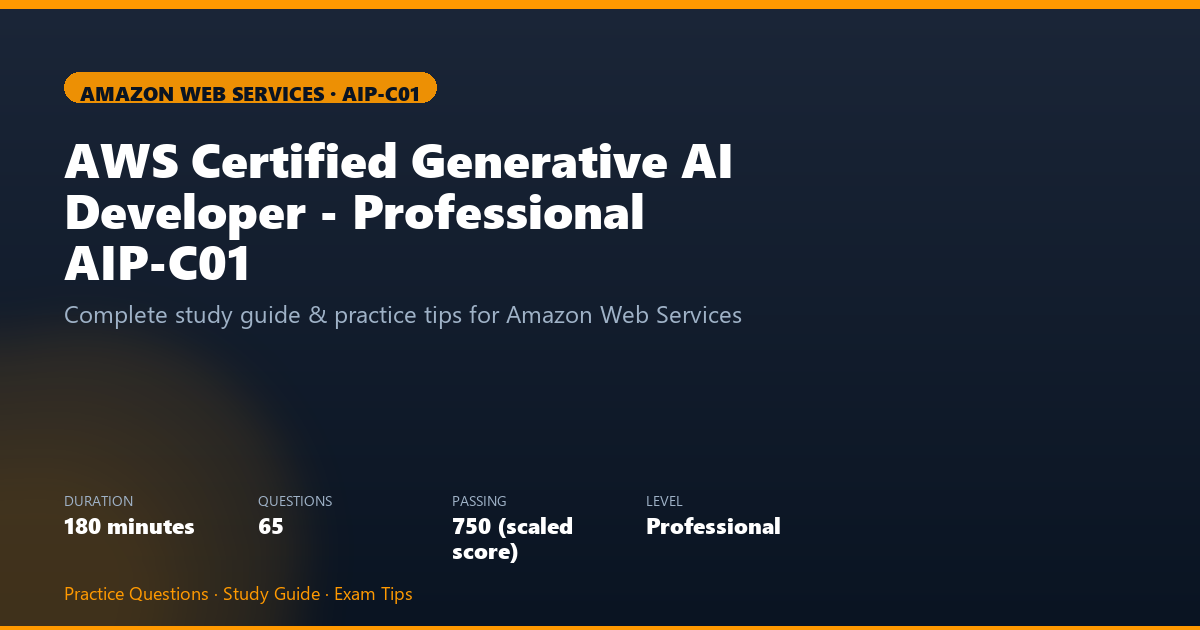
Detail Information Certification AWS Certified Generative AI Developer - Professional AIP-C01 Provider Amazon Web Services Exam Title AWS Certified Generative AI Developer - Professional AIP-C01 Duration 180 minutes Number of Questions 65 Passing Score 750 (scaled score) Exam Level Professional Prerequisites Candidates should have at least two years of hands-on experience developing, deploying, and optimizing generative AI solutions on AWS, along with a strong understanding of foundation models.
📑 Table of Contents
- AWS Certified Generative AI Developer â Professional (AIP-C01): Your Complete Exam Guide
- What Is the AWS Certified Generative AI Developer â Professional (AIP-C01) Certification?
- Exam Overview and Structure
- Key Topics Covered
- Study Tips and Preparation Strategy
- Common Challenges and How to Overcome Them
- Real-World Scenarios: What the Exam Feels Like
- Why Practice Exams Matter: Timed Testing, Detailed Explanations, and Structured Question Banks
- Conclusion and Next Steps
AWS Certified Generative AI Developer â Professional (AIP-C01): Your Complete Exam Guide
Youâve built RAG pipelines, tuned prompts until midnight, and deployed models behind API Gateway â but when a stakeholder asks whether your generative AI solution is production-ready, cost-effective, and responsible, can you answer with the same confidence you bring to a Jupyter notebook?
That gap between hands-on experimentation and professional-grade generative AI engineering is exactly what the AWS Certified Generative AI Developer â Professional (AIP-C01) certification is designed to measure. Whether youâre a machine learning engineer moving into LLM applications or a cloud architect standardizing GenAI across your organization, this exam validates that you can design, build, optimize, and operate generative AI solutions on AWS â not just prototype them.
What Is the AWS Certified Generative AI Developer â Professional (AIP-C01) Certification?
The AIP-C01 is AWSâs professional-level credential for developers and engineers who work with foundation models and generative AI on the AWS platform. Unlike introductory cloud certifications, this exam assumes you already understand ML fundamentals and focuses on the practical application of generative AI in real production environments.
Certification at a glance:
| Attribute | Details |
|---|---|
| Full name | AWS Certified Generative AI Developer â Professional |
| Exam code | AIP-C01 |
| Provider | Amazon Web Services (AWS) |
| Level | Professional |
| Validity | 3 years |
| Renewal | Pass the current exam or a higher-level AWS certification before expiration |
| Recommended experience | At least 2 years of hands-on experience developing, deploying, and optimizing generative AI solutions on AWS, plus strong foundation model knowledge |
This certification sits alongside AWSâs broader credential portfolio but addresses a rapidly evolving domain. AWS designed AIP-C01 to reflect how organizations actually use generative AI today: combining managed services like Amazon Bedrock and SageMaker, integrating with existing data pipelines, enforcing security guardrails, and managing cost at scale.
Passing AIP-C01 signals to employers and clients that you can move beyond demos â you understand architecture trade-offs, operational concerns, and the responsible use of AI systems in enterprise settings.
Exam Overview and Structure
Understanding the exam format before you study helps you calibrate your preparation and manage time on test day.
| Exam attribute | Specification |
|---|---|
| Duration | 180 minutes (3 hours) |
| Number of questions | 65 |
| Question format | Multiple choice and multiple response |
| Passing score | 750 (scaled score, out of 1000) |
| Delivery | Pearson VUE testing center or online proctored |
| Cost | Check the official AWS Certification page for current pricing |
At roughly 2.75 minutes per question, the pacing is demanding. Many items present lengthy scenario descriptions followed by several plausible answers. Youâre not being tested on memorizing service names in isolation â youâre being tested on judgment: choosing the right AWS service, architecture pattern, or operational approach given constraints like latency, budget, compliance, or data sensitivity.
The exam is divided across four domains (percentages may vary slightly):
| Domain | Focus area |
|---|---|
| Foundation Models and Generative AI Concepts | Model types, capabilities, limitations, fine-tuning vs. prompt engineering, embeddings, tokenization |
| Developing Generative AI Applications | Application design, RAG, agents, integration patterns, SDK usage |
| Optimizing, Deploying, and Operating GenAI Solutions | Performance tuning, cost optimization, monitoring, scaling, MLOps practices |
| Responsible AI and Security for Generative AI | Guardrails, content filtering, IAM, data privacy, bias mitigation, compliance |
Professional-level AWS exams typically include unscored pilot questions, so treat every question seriously even if some feel unfamiliar. Partial credit does not apply to multiple-response items â you must select all correct answers and only correct answers.
Key Topics Covered
Letâs break down what each domain expects you to know and how it shows up in real work.
Foundation Models and Generative AI Concepts
This domain establishes the vocabulary and mental models everything else builds on. Expect questions about:
- Model families: text, image, multimodal, and embedding models available through Amazon Bedrock and SageMaker
- Fine-tuning approaches: continued pre-training, instruction tuning, LoRA, and when each is appropriate
- Prompt engineering: zero-shot, few-shot, chain-of-thought, and system prompts
- Embeddings and vector search: how semantic similarity powers RAG architectures
- Model evaluation: BLEU, ROUGE, human evaluation, and task-specific benchmarks
Practical tip: Build a comparison table of foundation models youâve worked with â context window, cost per token, latency characteristics, and supported modalities. This mental reference helps you eliminate wrong answers quickly during the exam.
Developing Generative AI Applications
This is often the largest domain and the one most aligned with daily engineering work:
- Retrieval-Augmented Generation (RAG): chunking strategies, vector stores (Amazon OpenSearch, Aurora pgvector, Kendra), and retrieval quality
- Agents and tool use: Amazon Bedrock Agents, action groups, Lambda integrations
- Application architecture: API design, streaming responses, session management, conversation memory
- Data preparation: document ingestion, preprocessing pipelines, knowledge base configuration
- Integration patterns: connecting GenAI to existing applications via API Gateway, Lambda, Step Functions, and EventBridge
Optimizing, Deploying, and Operating GenAI Solutions
Production generative AI introduces unique operational challenges:
- Cost management: token budgeting, model selection trade-offs, caching, batch inference
- Performance optimization: provisioned throughput, model distillation, prompt compression
- Monitoring and observability: CloudWatch metrics, Bedrock invocation logging, custom evaluation pipelines
- Deployment patterns: blue/green deployments, A/B testing prompts and models, SageMaker endpoints
- Scaling: auto-scaling inference endpoints, handling traffic spikes, queue-based architectures
Responsible AI and Security for Generative AI
AWS places significant weight on building trustworthy AI systems:
- Amazon Bedrock Guardrails: content filters, denied topics, word filters, PII redaction
- Security: IAM policies, VPC endpoints, encryption at rest and in transit, KMS key management
- Data governance: handling sensitive data, audit logging, compliance frameworks
- Bias and fairness: evaluation for harmful outputs, diverse training data considerations
- Responsible AI principles: transparency, human oversight, and appropriate use cases
Study Tips and Preparation Strategy
A structured 8â12 week study plan works well for most candidates with the recommended two years of experience. Hereâs a proven approach:
Phase 1: Assess and Map (Week 1â2)
Take an initial practice assessment to identify weak domains. Read the official AWS exam guide and align it with services youâve actually used. If youâve never touched Bedrock Agents or Guardrails in production, flag those as priority learning areas.
Phase 2: Deep Dive by Domain (Week 3â8)
Study one domain per week, combining official AWS documentation with hands-on labs:
- Week 3â4: Foundation models â explore the Amazon Bedrock console, invoke different models, compare outputs
- Week 5â6: Application development â build a complete RAG application using Knowledge Bases for Amazon Bedrock
- Week 7: Optimization and operations â implement monitoring, analyze CloudWatch logs, experiment with provisioned throughput
- Week 8: Security and responsible AI â configure Guardrails, test IAM policies, review Well-Architected Framework for AI/ML
Hands-on is non-negotiable. The exam tests applied knowledge. Reading about RAG chunking strategies is useful; implementing three different chunk sizes and measuring retrieval quality is what makes the concept stick.
Phase 3: Integration and Review (Week 9â10)
Work through end-to-end scenarios that span multiple domains. Draw architecture diagrams from memory. Explain trade-offs out loud â if you can teach it, you know it.
Phase 4: Exam Simulation (Week 11â12)
Take full-length timed practice exams under realistic conditions. Review every incorrect answer thoroughly. Schedule the real exam when youâre consistently scoring above 80% on practice tests.
Recommended AWS Services to Know Cold
| Service | Why it matters for AIP-C01 |
|---|---|
| Amazon Bedrock | Core managed service for foundation model access, fine-tuning, agents, and guardrails |
| Amazon SageMaker | Custom model training, deployment, and MLOps |
| AWS Lambda | Serverless integration for GenAI workflows |
| Amazon OpenSearch Service | Vector search for RAG applications |
| Amazon S3 | Document storage for knowledge bases and training data |
| AWS IAM & KMS | Security, access control, and encryption |
| Amazon CloudWatch | Monitoring, logging, and alerting |
| AWS Step Functions | Orchestrating multi-step GenAI pipelines |
| Amazon Kendra | Enterprise search integration with GenAI |
| Amazon API Gateway | Exposing GenAI applications as APIs |
Common Challenges and How to Overcome Them
Every AIP-C01 candidate hits friction points. Recognizing them early saves time and frustration.
Challenge 1: Breadth Across Four Domains
Generative AI on AWS spans model theory, application code, infrastructure, and governance. Candidates strong in ML may struggle with IAM policies; cloud architects may stumble on fine-tuning techniques.
Solution: Donât study in silos. For every concept, ask: How would I build this? How would I secure it? How would I monitor it? How much would it cost? This cross-domain thinking mirrors the examâs scenario-based questions.
Challenge 2: Rapidly Evolving Service Features
Amazon Bedrock and related services receive frequent updates. Exam content reflects stable, broadly adopted features, but documentation changes quickly.
Solution: Anchor your study in the official exam guide domain outline rather than chasing every new feature announcement. Focus on foundational patterns â RAG, agents, guardrails, fine-tuning â that persist across service updates.
Challenge 3: Scenario-Based Question Fatigue
Sixty-five scenario questions over three hours is mentally exhausting. Long paragraphs describing a companyâs requirements can overwhelm you before you reach the actual question.
Solution: Develop a reading strategy. Skim for constraints first: budget limits, latency requirements, compliance needs, data sensitivity. Underline mentally (or on the provided whiteboard) the key requirements before reading answer choices.
Real-World Scenarios: What the Exam Feels Like
These scenarios reflect the kind of integrated thinking AIP-C01 demands.
Scenario 1: The Enterprise Knowledge Assistant
A financial services company wants an internal chatbot that answers questions about proprietary policy documents. The data contains PII, responses must cite source documents, and the legal team requires audit logging. Latency under five seconds is acceptable, but cost must stay within a monthly budget.
What you need to evaluate: Knowledge Bases for Amazon Bedrock vs. a custom OpenSearch pipeline, Guardrails for PII handling, chunking strategy for legal documents, IAM roles for least-privilege access, and CloudWatch logging for audit trails. The exam might ask which combination of services best meets all constraints â not just the most technically elegant solution.
Scenario 2: Scaling a Customer-Facing GenAI Feature
A e-commerce platform deploys a product recommendation chatbot using Bedrock. Traffic spikes during holiday sales cause latency to jump from 2 seconds to 15 seconds, and costs triple.
What you need to evaluate: Provisioned throughput vs. on-demand, prompt optimization to reduce token usage, caching frequent queries, auto-scaling patterns, and whether a smaller model handles the task adequately. Optimization questions often test whether you reach for the expensive solution first or apply systematic tuning.
Scenario 3: Multi-Model Agent Workflow
A healthcare startup builds an agent that schedules appointments, checks insurance eligibility, and summarizes patient intake forms. Each task requires different capabilities â structured data extraction, API calls, and natural language summarization.
What you need to evaluate: Bedrock Agents with action groups, Lambda functions for external API integration, model selection per task (not every step needs the largest model), HIPAA compliance considerations, and Step Functions for orchestrating complex workflows with error handling.
Working through scenarios like these during preparation builds the decision-making muscle the exam tests.
Why Practice Exams Matter: Timed Testing, Detailed Explanations, and Structured Question Banks
Reading documentation and building labs gets you halfway. The other half is learning to perform under exam conditions â and that requires deliberate practice with high-quality question banks.
The Case for Timed Practice
Knowledge and test-taking stamina are different skills. You might understand RAG architectures deeply but still miss questions because you spent six minutes on a single item and rushed through the last ten. Full-length, 180-minute timed practice exams replicate the pressure of pacing, building the rhythm of roughly 2.75 minutes per question.
Timed practice also reveals domain-level timing patterns. Maybe you fly through security questions but linger on optimization scenarios. That insight lets you adjust your exam-day strategy â flagging slow domains for review rather than getting stuck early.
Why Detailed Explanations Are Essential
Getting an answer wrong is valuable only if you understand why. A quality practice exam bank doesnât just mark answers correct or incorrect â it explains:
- Why the correct answer is the best fit given the scenarioâs constraints
- Why each distractor is plausible but wrong
- Which AWS documentation or pattern the question draws from
- What concept to revisit if you missed it
This feedback loop transforms practice exams from anxiety-inducing score checks into targeted study sessions. After each practice run, your review notes essentially become a personalized study guide focused on your actual gaps.
The Value of a Structured Question Bank
Random questions scraped from forums lack the coherence and coverage a structured question bank provides. A well-organized bank aligns questions to the four official exam domains, covers difficulty ranges from straightforward recall to complex multi-constraint scenarios, and includes enough volume that youâre not memorizing answers through repetition.
Look for question banks that offer:
| Feature | Benefit |
|---|---|
| Domain-aligned organization | Ensures balanced coverage; no over-studying RAG while neglecting responsible AI |
| Multiple difficulty levels | Builds confidence with fundamentals before tackling complex scenarios |
| Regular updates | Reflects current AWS service offerings and exam patterns |
| Performance tracking | Shows score trends by domain over time |
| Detailed rationales | Turns every question into a learning opportunity |
PDF Question Banks vs. Subscription Practice Platforms
Both formats serve distinct purposes in a well-rounded study plan.
PDF-style question banks excel as offline reference material. You can review questions during commutes, annotate tricky scenarios, and revisit missed concepts without an internet connection. They work well for domain-specific review sessions â say, spending an evening focused exclusively on Responsible AI and Security questions with rationales you can highlight and notes in the margin.
Subscription-based practice exam platforms add dynamic value: timed exam simulations, shuffled question sets that prevent memorization, progress dashboards, and regularly refreshed content. The ability to take a new full-length exam every week during your final preparation phase â each time with a different question mix â builds genuine readiness rather than answer recall.
The strongest candidates use both. PDF question banks for targeted domain review and commutes; subscription practice exams for weekly timed simulations and performance tracking during the final month. Together, they provide the repetition, coverage, and exam-condition practice that reading documentation alone cannot.
If youâre serious about passing AIP-C01 on your first attempt, invest in practice materials that match the examâs professional rigor. Generic cloud exam questions wonât prepare you for the generative-AI-specific scenarios this certification demands.
Conclusion and Next Steps
The AWS Certified Generative AI Developer â Professional (AIP-C01) certification is more than a credential â itâs a structured validation that you can engineer generative AI solutions that are functional, efficient, secure, and responsible. In a field where hype often outpaces production readiness, that distinction carries real professional weight.
Your action plan:
- Download the official exam guide from AWS and map each domain to your current experience
- Identify gaps â be honest about services youâve read about but never deployed
- Build hands-on projects â a RAG application, a Bedrock Agent, and a Guardrails configuration cover substantial exam territory
- Study across domains simultaneously â integrate security and cost considerations into every architecture you design
- Incorporate practice exams into your final month â use structured question banks for domain review and full-length timed simulations for exam readiness
- Schedule your exam when practice scores consistently exceed 80% with clear understanding of every missed question
The generative AI landscape will keep evolving, but the engineering fundamentals this exam tests â sound architecture, operational excellence, and responsible deployment â are durable skills that compound throughout your career.
Start with your weakest domain today. Build something real on AWS. Then test yourself under exam conditions until the scenarios feel familiar rather than intimidating.
Youâve already done the hard work of learning generative AI. AIP-C01 is your opportunity to prove you can do it professionally.
Pass the exam with our practice question bank
Timed multiple-choice practice is one of the fastest ways to close knowledge gaps before test day. Use our PDF question banks for offline review and subscribe to the practice exam question bank for full access to realistic items, explanations, and a study flow aligned to the official blueprint.
- Question bank scope: Prep coverage tied to AWS Certified Generative AI Developer - Professional AIP-C01 draws from a curated pool of 65 discussion-grounded practice prompts aligned to the blueprint (totals reflect the dataset backing this guide).
- Learner benchmarks: 94% — Students found the real exam almost same
- Learner benchmarks: 1057 — Students passed this exam after ExamTopic Prep
Start practicing for this exam
Disclaimer: This blog post is for educational purposes only. Certification exam details may change over time. Always refer to the official certification provider for the most up-to-date information.
Comments
No comments yet. Be the first to share your thoughts.